

What the USMCA Review Means for North American Competitiveness

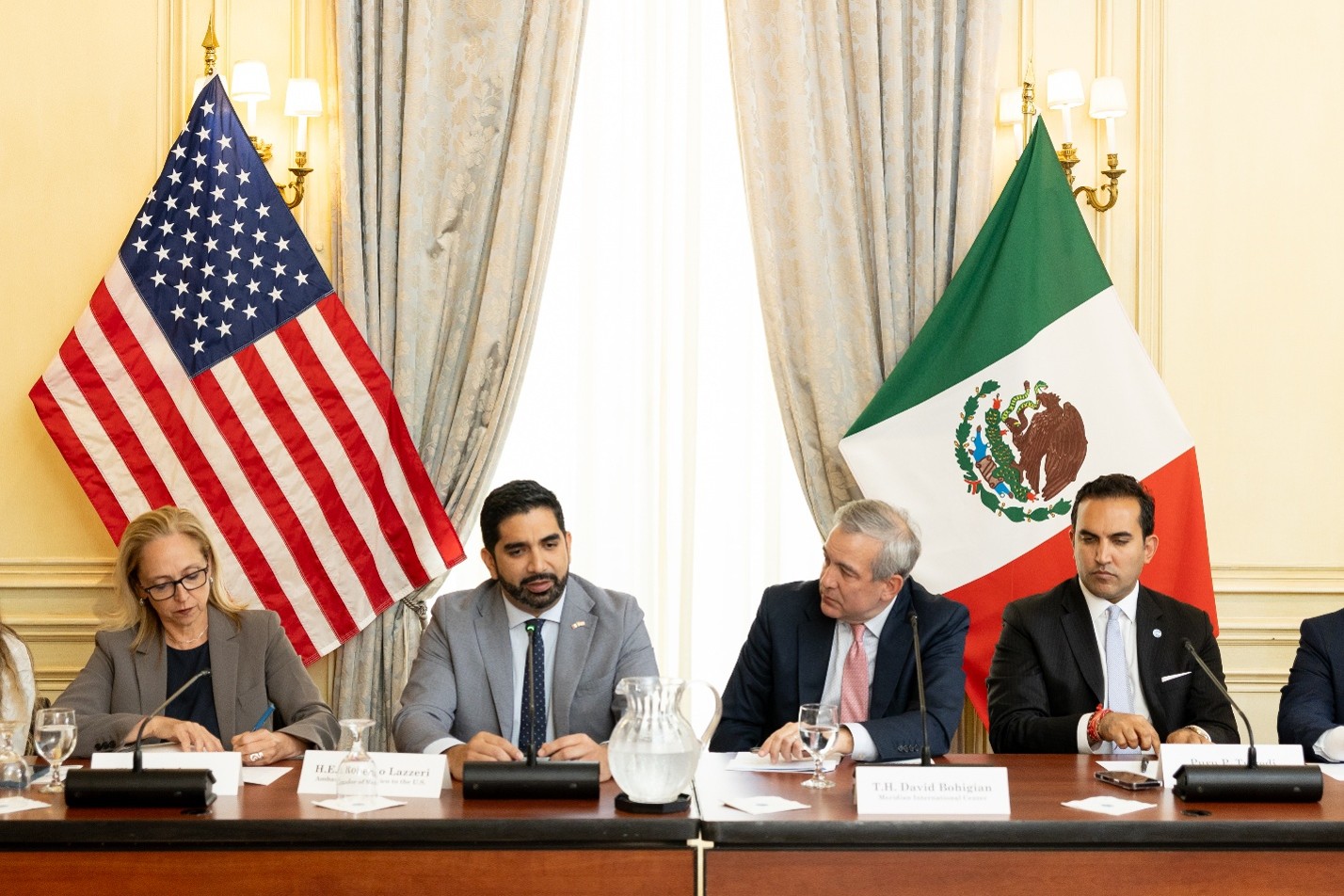
The current review of the United States-Mexico-Canada Agreement (USMCA) comes at a pivotal moment for North America. Tariffs, industrial policy, supply chain security, and competition with non-market economies are reshaping where companies invest and how goods are produced. On July 16, Meridian International Center convened a Global Business Briefing featuring His Excellency Roberto Lazzeri, Ambassador of Mexico to the United States, to examine how the United States and Mexico can use this moment to provide greater certainty for business, reinforce regional production, and strengthen North America's long-term competitiveness. The program was moderated by Meridian CEO David Bohigian and brought together senior business leaders for a discussion on the future of regional trade and investment.
1. The USMCA review should create greater certainty for long-term investment.
For companies making investment decisions that span decades, predictability matters as much as market access. The current review presents an opportunity to modernize the agreement to reflect new production methods, evolving supply chains, and emerging industries while giving businesses greater confidence to invest across North America. Clearer rules on origin, traceability, and strategic sectors can reduce uncertainty created by Section 232 tariffs, Section 301 investigations, and shifting policy signals, helping companies plan for long-term growth instead of short-term disruption.
2. North America competes best as a co-production system.
Manufacturing across North America functions as an integrated production platform rather than three separate national economies. Automotive, aerospace, agriculture, semiconductors, medical technology, and other industries rely on supply chains that move components across borders before reaching consumers. Viewing regional competitiveness primarily through bilateral trade balances overlooks the strategic advantage this integration creates. The more important question is whether North America is gaining market share against competitors outside the region.
3. Trade policy should reinforce—not redirect—North American production.
The United States and Mexico broadly share the same objective: reducing dependence on non-market economies while strengthening regional manufacturing. Yet policies intended to protect domestic industry can produce unintended consequences if they shift sourcing toward markets such as Vietnam, Malaysia, or Indonesia instead of encouraging production within North America. A more effective approach would pair enforcement with coordinated regional investment, stronger North American sourcing, and joint action against transshipment and circumvention to keep production and investment within the region.
4. Businesses should help shape the next generation of trade rules.
Governments negotiate trade agreements, but businesses understand how products are designed, manufactured, and moved across borders. That expertise is important in industries such as semiconductors and artificial intelligence, where export-control regimes, access to advanced technology, energy demand, and water requirements all shape investment decisions. Continued engagement with industry can help policymakers strengthen economic security while ensuring new trade rules remain commercially viable and reflect operational realities.
5. Strong institutions are a competitive advantage.
Long-term economic partnerships depend on more than shared interests—they require durable frameworks that outlast political cycles. Clear objectives, measurable benchmarks, and regular government-to-government engagement create greater transparency while reducing uncertainty for businesses operating across borders. By institutionalizing cooperation instead of relying on ad hoc negotiations, North America can lower investment risk, strengthen investor confidence, and create a more stable foundation for regional competitiveness.




Project summary
| What the USMCA Review Means for North American Competitiveness | July 2026 | |
|---|---|
| Program Areas: | Corporate Diplomacy |
