

Supply Chain Resilience Requires More Than Reshoring

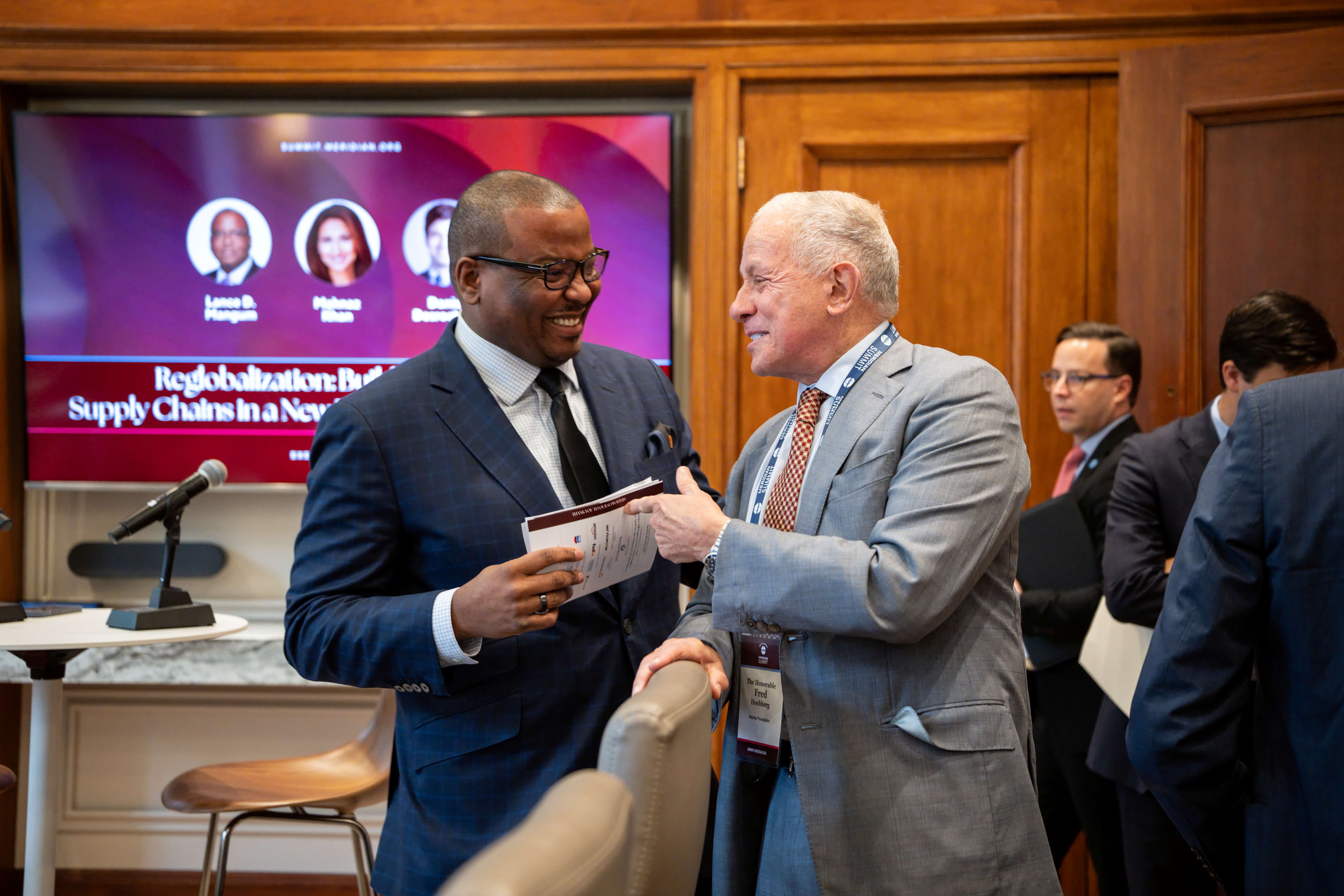
On the sidelines of the 15th annual Meridian Summit held on October 16, 2026, Meridian convened an Executive Briefing “Reglobalization: Building Resilient Supply Chains in a New Era of Global Commerce” on how public-private partnerships can strengthen supply chain resilience and global competitiveness. The discussion, featuring opening remarks from Lance Mangum, Vice President, Government Affairs at FedEx Corp, Mahnaz Khan, Vice President of Policy for Critical Supply Chains at Silverado Policy Accelerator, and moderated by Daniel Desrochers, International Trade Reporter at POLITICO, examined the growing convergence of trade policy, economic security and national security, with particular attention to logistics, critical minerals and advanced manufacturing.
Participants emphasized that resilience does not mean producing everything at home. It requires reliable visibility into global networks, targeted investment in strategic sectors, trusted international partnerships and a workforce capable of operating increasingly automated supply chains.
Here are the top takeaways:
1. Visibility Is the First Line of Supply Chain Defense
Resilience begins with knowing where goods are, where bottlenecks are forming and how quickly routes can change. Global logistics networks provide early warnings when customs delays, conflict or infrastructure disruptions threaten the movement of essential products. FedEx reports that its network transports more than $2 trillion in goods annually and serves more than 220 countries and territories, illustrating the scale of information available to companies that connect physical shipments with real-time data. Governments and businesses should treat trade facilitation, customs modernization and shipment visibility as core elements of economic security, not simply operational efficiencies.
2. Strategic Markets Need Strategic Capital
Markets alone may not build sufficient capacity in sectors where projects are costly, timelines are long and foreign competitors benefit from nonmarket support. Targeted grants, loans, equity investments and purchase commitments can reduce risk for critical-minerals processing, foundational semiconductors and advanced manufacturing while drawing in private capital. The United States remained fully reliant on imports for 16 nonfuel mineral commodities in 2025 and depended on imports for more than half of its consumption of 54 commodities. Public support should therefore be tied to clear strategic gaps, transparent guardrails and measurable outcomes rather than applied broadly across the economy.
3. Allied Resilience Requires a Full-Package Approach
Diversifying away from concentrated suppliers requires more than financing a mine. Competitive alternatives must connect extraction with processing, transportation, ports, reliable power and access to customers, often across several countries. The G7 has committed to coordinating production, processing and recycling projects across the full critical-minerals value chain with partner countries. That model gives allies complementary roles and offers producing countries greater local value, but it will succeed only if partnerships are trusted, durable and responsive to community priorities.
4. China’s Critical-Mineral Advantage Is Now a Source of Trade Leverage
China’s control over critical-mineral supply chains has become a powerful bargaining chip in its trade dispute with the United States. Export restrictions on rare earths and permanent magnets have exposed the vulnerability of industries that rely on materials largely processed in China. To reduce that leverage, the United States must take a more strategic approach by investing across the full supply chain and coordinating those efforts with allies that can provide complementary resources, expertise and production capacity.
5. A Prepared Workforce Is a Supply Chain Necessity
New mines, processing facilities and automated factories cannot operate without workers trained for the industries of the future. The discussion highlighted how China has developed specialized undergraduate programs in rare-earth science, while American students generally pursue broader degrees in geology, mining or metallurgy. At least 11 Chinese universities and technical colleges collectively enroll more than 500 students annually in rare-earth degree programs, while U.S. institutions awarded just over 200 undergraduate mining and metallurgical engineering degrees in 2023 and no institution outside China was identified as offering a dedicated undergraduate rare-earth degree. Building more resilient supply chains will require the United States to be equally deliberate about developing specialized expertise, connecting university programs to critical industries and retaining graduates with advanced processing knowledge.





Project summary
| Supply Chain Resilience Requires More Than Reshoring | October 2026 | |
|---|---|
| Program Areas: | Diplomatic Engagement |
