

Space Diplomacy Post-ISS
As the International Space Station (ISS) approaches retirement, the future of space exploration is shifting toward commercial platforms, lunar missions, and broader cross-border participation.
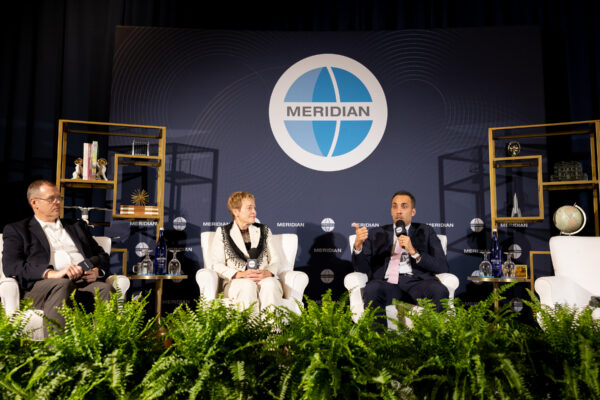
This panel explored how the diplomatic legacy of the ISS can be preserved and expanded in an increasingly complex, multipolar space environment. Featuring H.E. Salem Humaid Al Marri (Director General, Mohammed Bin Rashid Space Centre), Dr. Jeff Foust (Author, SpaceNews), and Astronaut Peggy Whitson (Vice President of Human Space Flight, Axiom Space), the discussion highlighted how international cooperation will define the next phase of human spaceflight.
Here Were the Top Takeaways from the Program:
1. The ISS legacy is diplomatic as much as technical
The ISS’s greatest achievement may not be engineering, but diplomacy. As Whitson noted, “that international partnership will be the legacy of the ISS,” underscoring how decades of allied engagement has built trust across geopolitical divides. Foust framed the station as a model of sustained cooperation, even suggesting it has been worthy of a Nobel Peace Prize. The ISS created a durable framework for multinational collaboration that must be intentionally carried forward. This legacy provides a foundation for future partnerships in an increasingly complex global ecosystem.
2. “Commercial space stations will expand access and participation
The evolution from government-led platforms to commercial space stations is expected to significantly broaden participation in the domain. Whitson highlighted that Axiom missions have already included astronauts from 11 countries, demonstrating how new structures can scale inclusion. As she explained, “we have to ensure that we are providing access to space in new and different ways that will invite more people rather than fewer people into the inner circle.” Al Marri reinforced this transition, noting that emerging systems will combine public and private actors to distribute cost and opportunity more sustainably. Together, these developments signal a democratization of the final frontier access beyond traditional superpowers.
3. New entrants are reshaping space diplomacy
Countries like the UAE are redefining how nations can engage in space without legacy infrastructure. Al Marri described their ISS participation as “a model of what you can do, even though you have not built and created the station,” demonstrating how smaller or newer actors in the domain can integrate meaningfully. Through targeted investments, such as astronaut programs, lunar rovers, and Gateway contributions, these nations are positioning themselves as active collaborators. This evolution reflects a broader shift toward flexible, modular participation in global efforts in the sector. The result is a more inclusive and dynamic diplomatic landscape.
4. The moon will be the next frontier for multilateral cooperation
Looking beyond Low Earth Orbit, lunar exploration is a major arena for international collaboration. Al Marri emphasized that initiatives like the Artemis program and its frameworks signal “this is the way we intend to explore the moon… collaboratively.” Participation in efforts such as the Gateway and lunar surface missions allows countries to contribute specialized capabilities while sharing in the broader mission. Whitson added that operational integration, training, logistics, and mission execution, will be just as critical as high-level agreements. The moon is emerging not only as a scientific destination, but as a testing ground for new governance mechanisms.
5. The future of space depends on sustained international cooperation
Despite increasing complexity, including multiple platforms and competing approaches, panelists were clear that coordination remains essential. Whitson stressed, “the only way that we’re going to do this effectively is to have those cross-border relationships,” highlighting partnership as a prerequisite for sustainable exploration. Al Marri suggested that future governance may not rely on a single framework like the ISS agreements, but rather a mix of multilateral accords and bilateral partnerships. By 2040, both envisioned a world with human activity on the moon and potentially steps toward Mars — achievements that will depend on collective effort. The next era of space exploration will succeed or fail based on the strength of its diplomatic foundations.