

Space as Strategic Infrastructure: Allies, Industry, and National Security

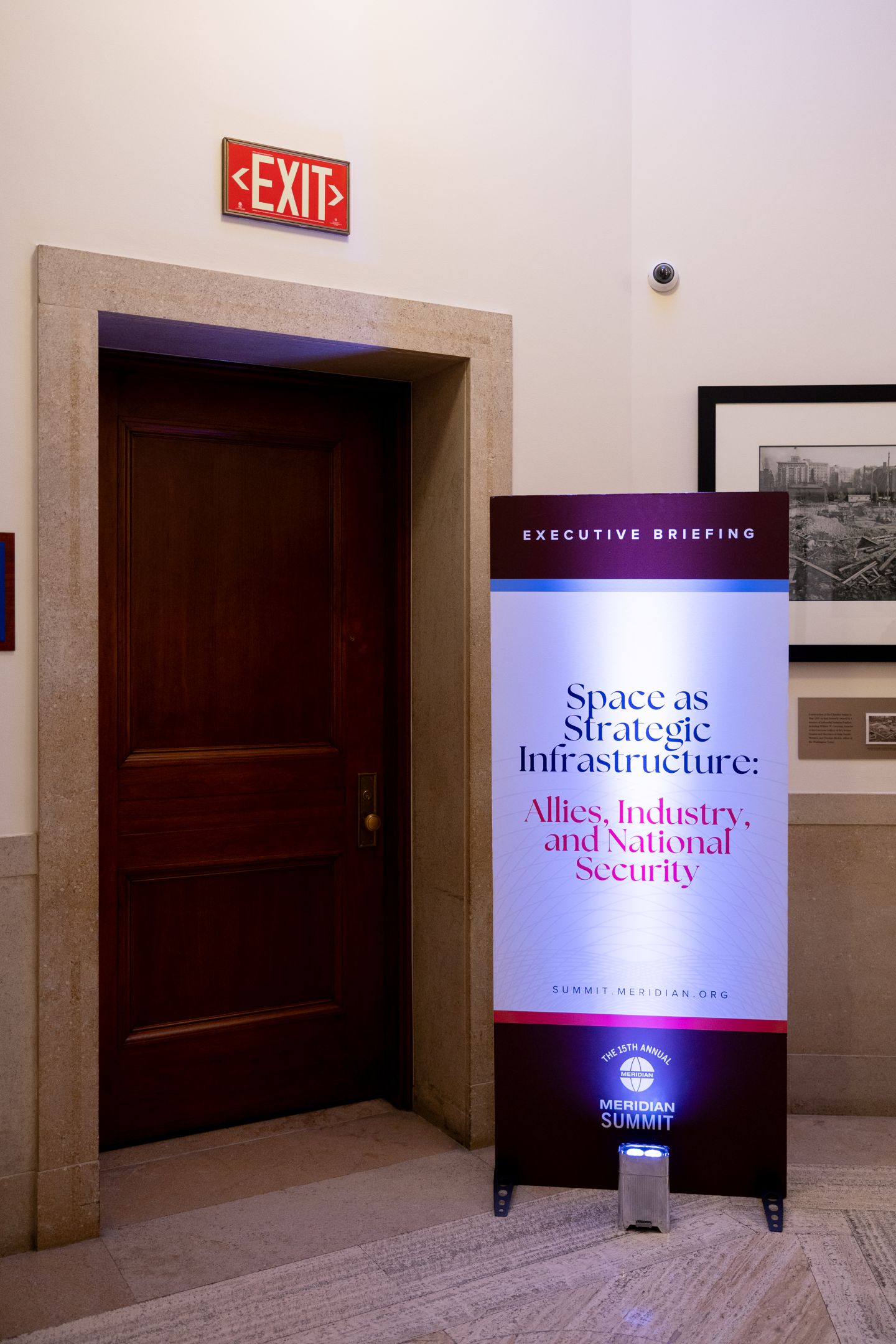
On the sidelines of the 2026 Meridian Summit, in an executive briefing titled “Space as Strategic Infrastructure: Allies, Industry, and National Security,” Dr. Brian Weeden, Director of Civil and Commercial Policy at the Center for Space Policy and Strategy, and Theresa Hitchens, Senior Space Reporter at Breaking Defense, joined an audience of executive leaders for a discussion on how space policy and infrastructure has become indispensable to national security, economic resilience, and strategic competition. The conversation explored the growing role of commercial providers, the importance of allied cooperation in space, emerging questions surrounding military operations and deterrence, and the governance challenges that arise as space-based capabilities become critical infrastructure underpinning both modern economies and defense operations.
Here are the top takeaways:
1. Space is no longer a niche domain. It has become essential strategic infrastructure
Space-based systems now underpin everything from military communications and intelligence collection to missile defense, precision targeting, navigation, and economic activity. As governments, businesses, and societies become increasingly dependent on these capabilities, disruptions in space systems could have consequences far beyond the aerospace sector, elevating space from a supporting function to a core pillar of national resilience and security.
2. Private companies have become consequential national security actors
Capabilities once provided almost exclusively by governments, including satellite communications, imagery, launch services, and even human spaceflight, are now increasingly delivered by private industry. This shift has accelerated innovation and expanded access, but it has also created a reality in which commercial firms play consequential roles in national security and geopolitics, whether they intend to or not.
3. The Ukraine conflict exposed both the value and vulnerability of commercial space dependence
The use of Starlink and Starshield in Ukraine demonstrated how commercial space systems can provide critical operational advantages during conflict. At the same time, questions surrounding service availability, decision-making authority, and the respective roles of companies and governments highlighted the risks of relying on privately controlled infrastructure during crises. These concerns are prompting allies to examine alternative capabilities and diversify their space architecture.
4. Allied cooperation in space is expanding, but its future cannot be taken for granted
U.S. space partnerships have grown significantly over the past two decades, expanding from a relatively limited group of close partners to a much broader coalition of allies. Yet participants questioned whether geopolitical tensions and shifting political relationships could complicate future cooperation. As space becomes increasingly central to deterrence, resilience, and operational effectiveness, maintaining trust and interoperability among allies will become even more important.
5. Governance and military coordination are struggling to keep pace with the changing space environment
As space capabilities become more central to military operations, policymakers face increasingly complex questions about conflict, responsibility, and escalation. The discussion highlighted debates over whether cyberattacks and electronic warfare against space systems constitute space warfare, as well as uncertainties regarding command responsibilities and international norms. Meanwhile, efforts to build consensus through multilateral institutions continue to face significant challenges amid growing geopolitical competition.




Project summary
| Space as Strategic Infrastructure: Allies, Industry, and National Security | October 2026 | |
|---|---|
| Program Areas: | Diplomatic Engagement |
