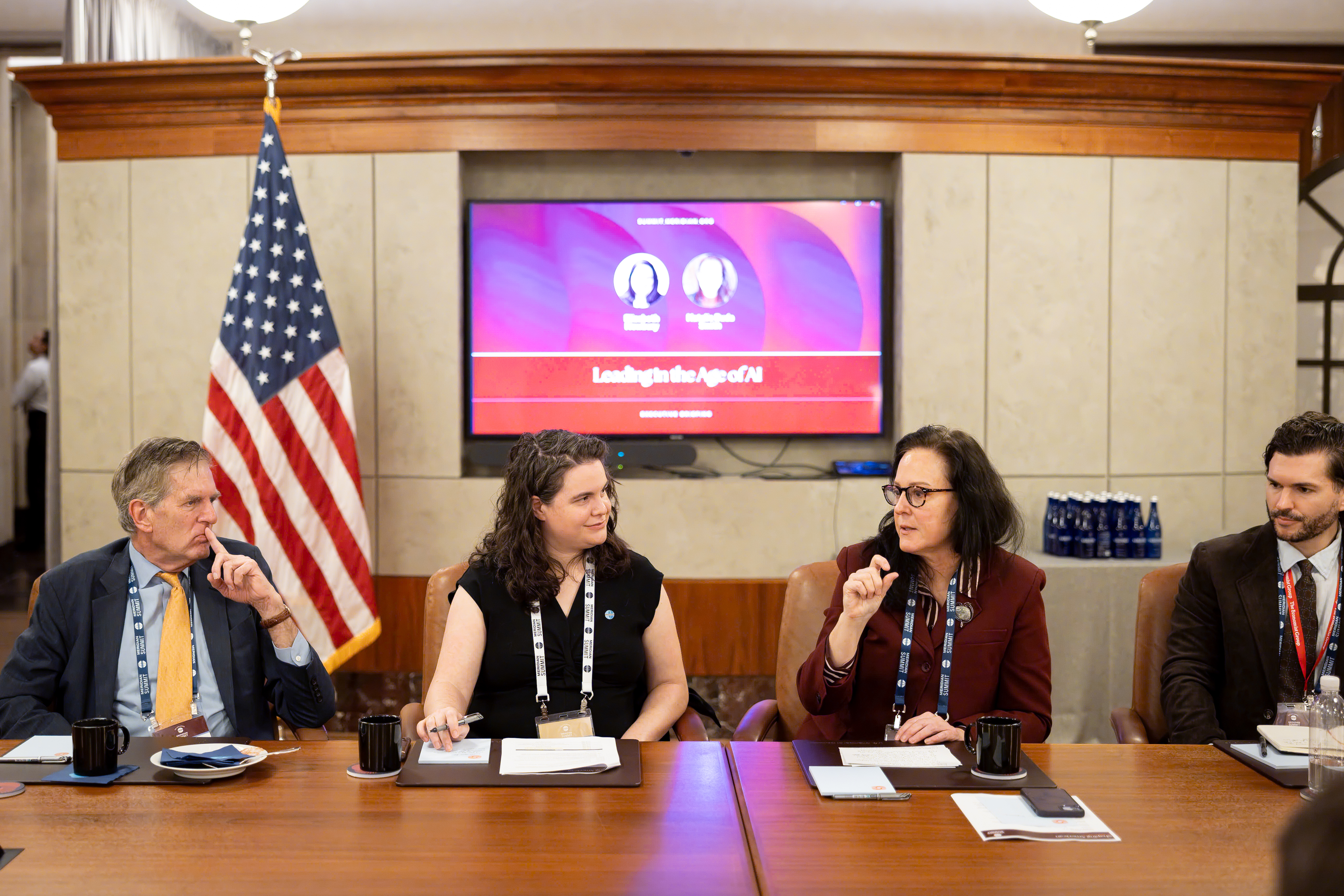
Leading in the Age of AI

On the sidelines of the 2026 Meridian Summit, in an executive briefing titled "Leading in the Age of AI," Natalie Buda Smith, Director of AI and Innovation at the Library of Congress, joined Dr. Elizabeth M. H. Newbury, Senior Director for the Center for Technology, Innovation, and Space at Meridian, for a conversation with senior executives on how leaders can responsibly adopt artificial intelligence while maintaining trust, expertise, and institutional integrity.
Drawing on Smith's experience leading AI innovation at the Library of Congress, as well as insights from Meridian's Tech Labs community, the discussion explored how organizations can foster experimentation, empower employees to shape technological change, build confidence in emerging technologies, and ensure that AI serves as a complement to human judgment rather than a replacement for it. Participants also examined the leadership challenges associated with deploying AI at scale, from workforce adoption and data governance to preserving trust in AI-enabled decision-making.
Here are the top takeaways:
1. The people closest to the work should shape how AI is used
Successful AI adoption begins with the employees who understand a workflow best. Rather than imposing AI solutions from the top down, organizations should empower staff to help design, test, and refine how AI is integrated into their daily work. Those closest to operational challenges are often best positioned to identify where automation adds value and where human expertise remains essential.
2. Experiment before you implement
Participants emphasized the importance of piloting AI tools before scaling them across an organization. Leaders should create space for experimentation, evaluate results, understand risks, and learn how technologies perform in practice before committing to enterprise-wide adoption. Responsible innovation requires curiosity, testing, and iteration rather than rushing to implementation.
3. Trust remains the most important measure of success
Organizations are judged not only on efficiency, but on the reliability and authenticity of the information they provide. AI must earn trust just as institutions do. Participants discussed the importance of validating outputs, understanding source data, and asking whether AI-generated content represents "the truth, the whole truth, and nothing but the truth." Maintaining public and employee confidence should be a central consideration in any AI strategy.
4. AI works best when it augments expertise, not replaces it
The discussion repeatedly returned to the value of human judgment. AI can generate drafts, surface information, and reduce administrative burdens, but subject-matter experts remain responsible for interpretation, critical thinking, and decision-making. Leaders should position AI as a tool that enhances professional expertise, allowing employees to focus on higher-value analysis and problem-solving.
5. The future of AI is not one tool for everyone, but the right tool for the right task
Organizations should resist the temptation to view AI as a single solution. Different functions require different models, datasets, and capabilities. Institutions like the Library of Congress are increasingly adopting specialized AI solutions tailored to specific workflows, demonstrating that successful implementation depends on aligning tools with distinct user needs, data environments, and organizational objectives rather than relying on a one-size-fits-all strategy.