

Keynote Remarks by NASA Administrator Jared Isaacman
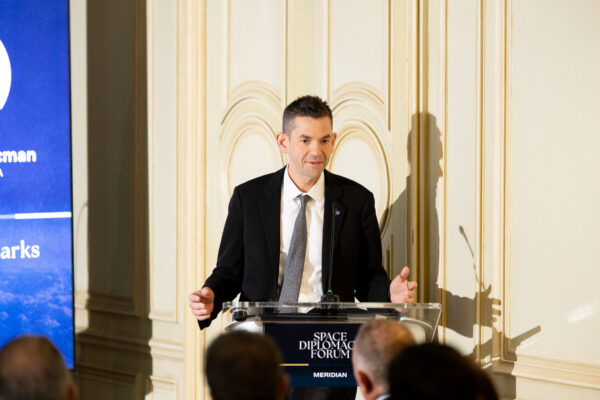
NASA Administrator Jared Isaacman’s keynote, delivered one day after NASA’s “Ignition” announcement, outlined a significant reorientation of U.S. space policy toward speed, execution, and sustained operational presence across lunar and orbital domains. Framed against intensifying geopolitical competition and quicker timelines for results, the address positioned NASA as entering a new phase defined less by long-term program planning and more by rapid delivery and iterative capability-building.
Central to this shift is the transition from episodic exploration to enduring infrastructure—on the Moon, in low Earth orbit, and beyond—supported by expanded commercial participation and deepened international partnership. The remarks collectively signal an effort to align institutional structure, industrial capacity, and allied engagement around a single imperative: action at pace in a strategically contested space environment.
Here Were the Top Takeaways from the Program:
1. Space is now characterized by compressed timelines and geopolitical urgency, not long-cycle planning
The space environment is entering a fundamentally different phase defined by accelerating capability development and intensifying geopolitical competition. “Success and failure is not measured in years, but measured in months,” underscoring a reorientation toward shorter operational cycles and immediate delivery pressure. Strategic advantage is increasingly tied to speed of delivery, institutional responsiveness, and the ability to iterate rapidly under competitive conditions. This narrows decision-making windows and raises the cost of delays across both government and industry actors.
2. “Ignition” signals a shift from fragmented priorities to execution-driven mission focus
NASA’s internal structure is being reoriented around eliminating fragmentation and concentrating effort on a narrower set of national priorities. The emphasis is on moving away from accumulated “side quests” that dispersed resources and slowed delivery across programs. “We were distracted from the world-changing mission that American taxpayers have entrusted us with,” reflecting a deliberate pivot toward accountability marked by outcomes rather than process. The objective is to convert institutional alignment into persistent implementation capacity at scale.
3. International partners are being positioned as embedded contributors to a shared exploration environment
Rather than peripheral participation, global engagement is being structured as an integral part of lunar and orbital architecture, with partner capabilities directly integrated into infrastructure development, surface systems, and mission operations. The realignment toward a permanent lunar presence and a commercialized low Earth orbit creates multiple entry points for technical, scientific, and industrial contributions from allied space agencies and industry. This model frames cooperation as co-development of a shared operational ecosystem rather than discrete bilateral projects. In this context, partnership value lies in sustained engagement in an infrastructure designed for continuous exploration and expansion, captured in Isaacman’s closing commitment: “The greatest days of exploration and discovery are certainly ahead of us, and we look forward to building that future alongside all of you.”



Project summary
| Keynote Remarks by NASA Administrator Jared Isaacman | March 2026 | |
|---|---|
| Program Areas: | Technology, Innovation, & Space |
