

Insights@Meridian with James Blair: White House Priorities on Trade, Security, and Global Engagement
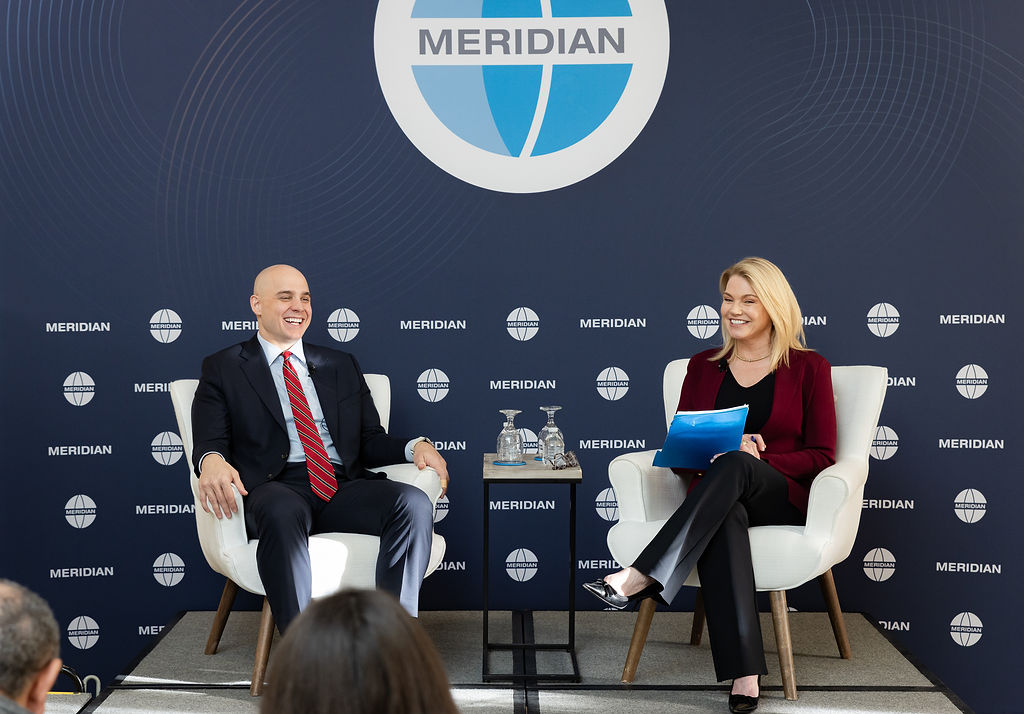
As the United States moves through a period of economic uncertainty, geopolitical fragmentation, and tightening political margins in Congress, Washington is recalibrating its domestic and international strategy around resilience. These pressures are converging just as the U.S. approaches a midterm cycle in which economic performance, security risks in the Caribbean, and the durability of U.S.–allied industrial cooperation carry greater weight. On December 3, 2025, Assistant to the President and White House Deputy Chief of Staff James Blair joined Meridian for a conversation on the Administration’s assessment of 2025 and priorities for the coming year.
Here were the top takeaways from the program.
1. The Economic Landscape Is Driving the National Agenda
Economic pressures continue to shape the national mood heading into 2026. Voters across the country remain acutely focused on affordability, wages, and long-term stability, placing economic resilience at the center of political strategy. Inflation’s lingering impact—felt globally, not just domestically—has elevated issues such as healthcare pricing, housing affordability, and wage growth into top-tier priorities. As a result, policy planning increasingly centers on everyday economic concerns rather than broader ideological debates. Recent electoral patterns reflect this trend. Local and special-election results show that shifts in turnout, rather than shifts in ideology, continue to define competitive outcomes. This dynamic places pressure on policymakers to offer clear, forward-looking commitments and not simply restate recent accomplishments. Economic plans for the year ahead are being framed around visible and near-term benefits for working households, from targeted tax relief to efforts to reduce structural costs in healthcare and housing.
2. Trade Is Becoming a Primary Tool of U.S. Leverage
Trade now occupies a central role in Washington’s strategic posture. In the wake of pandemic-era disruptions, policymakers are reassessing long-held assumptions about open markets, supply-chain geography, and the long-term costs of dependency. A broad-based tariff architecture has created a framework that can now be tuned in response to real-time vulnerabilities. Countries that engage early in trade negotiations tend to secure more predictable outcomes, reflecting a shift toward timeliness and constructive engagement as factors in final agreements.Rather than front-loading carveouts, policymakers appear to be allowing market behavior and supply-chain stress points to surface naturally before making targeted changes.
3. Industrial Strategy Is Shifting Toward Allied Integration and Strategic Self-Reliance
Securing critical minerals, advanced manufacturing inputs, and energy capacity has become one of Washington’s most urgent long-term priorities. The vulnerabilities exposed in global supply chains have accelerated efforts to both onshore production and deepen industrial integration with trusted partners. Cooperative production arrangements demonstrate how industrial capacity is being distributed among allies to reduce shared vulnerabilities. Washington’s willingness to take equity stakes in companies central to national security represents a shift in philosophy: strategic independence may require more direct public involvement than in previous eras. This approach diverges from traditional subsidy models by emphasizing returns and long-term security rather than one-time financial transfers.
4. Security Strategy in the Caribbean Reflects a Broader Redefinition of National Defense
The expanding U.S. security footprint in the Caribbean reflects an evolving assessment of threats posed by narcotics trafficking and transnational criminal networks. With fentanyl-related deaths rising sharply in the United States, synthetic drugs are increasingly treated as a national-security concern rather than solely a law-enforcement issue. This recalibration has contributed to targeted airstrikes, increased naval presence, and more assertive regional engagement designed to disrupt supply routes before they reach U.S. borders. Broader regional instability—including political uncertainty in Venezuela and shifting migration patterns—continues to influence Washington’s calculations. As attention concentrates on conflicts in Europe and the Middle East, the Western Hemisphere remains a crucial theater, particularly where domestic safety and geopolitical risk overlap. The emerging strategy blends economic diplomacy, law-enforcement partnerships, and calibrated military posture to manage a complex and rapidly evolving set of regional challenges.
5. Conflict Mediation Abroad and Legislative Constraints at Home Shape the Year Ahead
Efforts to de-escalate conflicts abroad continue to be a defining feature of U.S. engagement. The landscape includes ceasefire in Gaza, ongoing negotiations in Eastern Europe, diplomatic mediation in the Caucasus and Southeast Asia, and stabilization efforts in parts of Africa. Conflict resolution is being pursued through economic frameworks that aim to give adversaries and neighbors alike a stake in long-term stability. At home, legislative dynamics remain unusually constrained. Slim majorities have narrowed the window for major policy breakthroughs, and prolonged confirmation delays have slowed policymaking in areas that traditionally depend on high-level diplomatic staffing. With another government funding deadline approaching, the structural challenges of divided government continue to shape expectations for the coming year.




Project summary
| Insights@Meridian with James Blair: White House Priorities on Trade, Security, and Global Engagement | |
|---|---|
| Program Areas: | Diplomatic Engagement |
