

Global Business Briefing with The Hon. Caleb Orr, Assistant Secretary of State for Economic, Energy, and Business Affairs
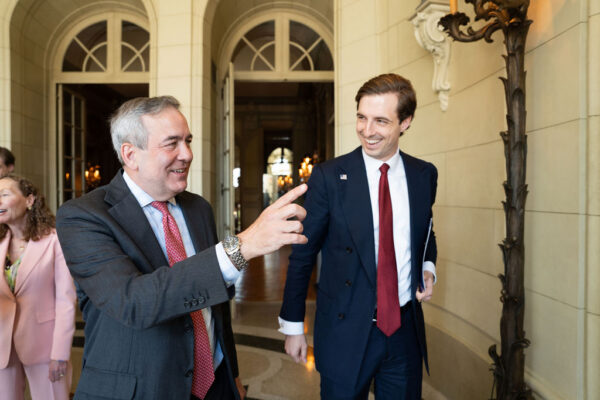
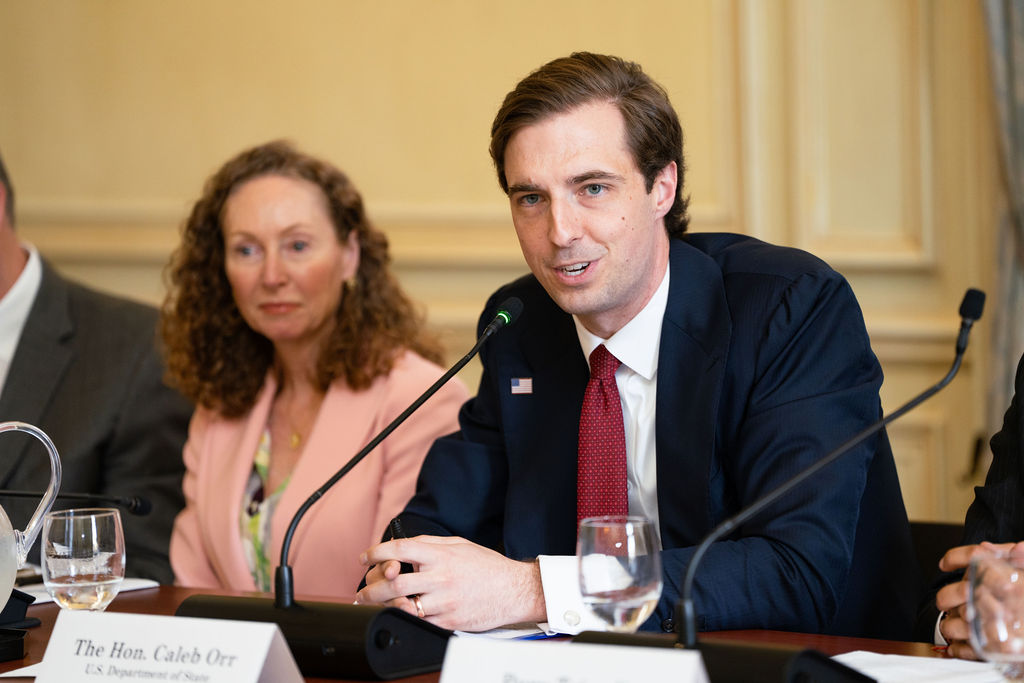
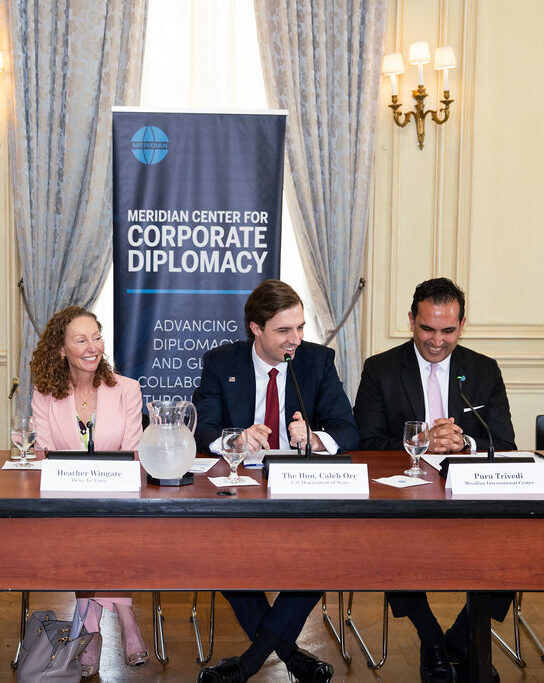
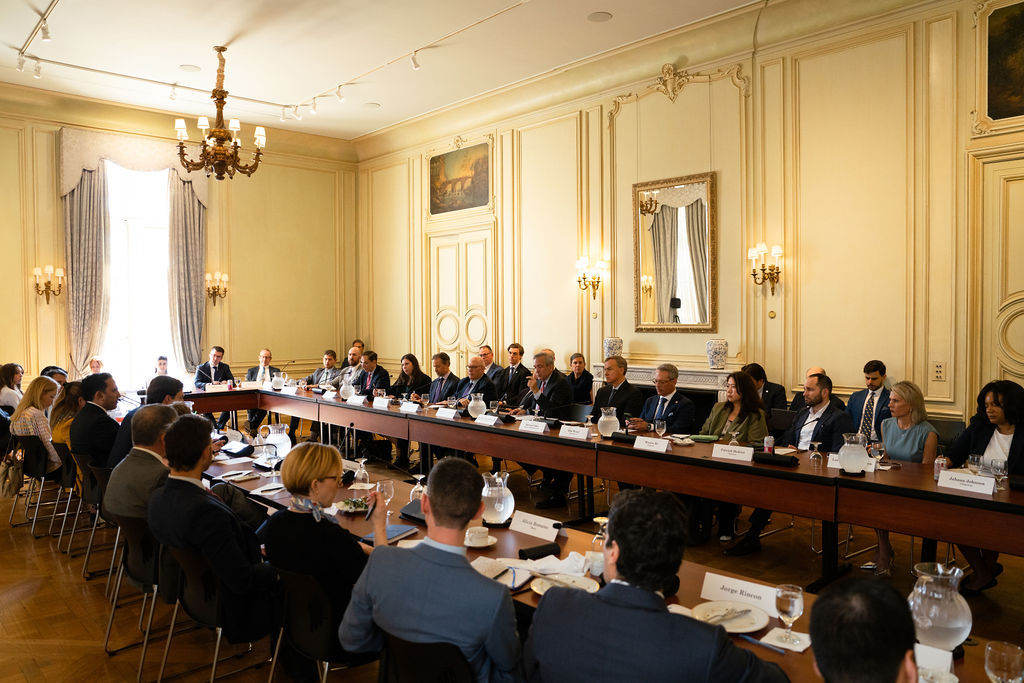
As economic competition reshapes global relationships, the United States is executing foreign policy through markets, investment, and commercial diplomacy as much as through traditional channels. On March 31, 2026, Meridian convened a Global Business Briefing with The Hon. Caleb Orr, Assistant Secretary of State for Economic, Energy, and Business Affairs.
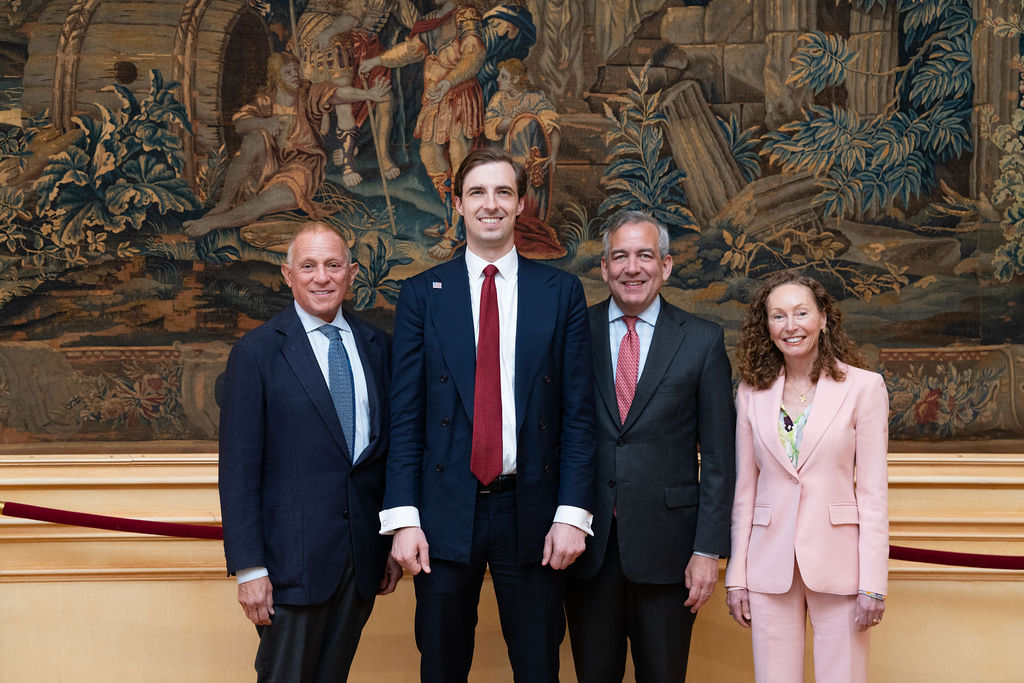
T.H. David Bohigian, Chief Executive Officer of Meridian International Center, Puru Trivedi, Senior Vice President of Meridian International Center, and Heather Wingate, Senior Vice President of Government Affairs at Delta Air Lines, opened the program by framing the expanding role of commercial diplomacy in advancing U.S. strategic interests. The United States is elevating economic statecraft from a supporting function to a primary instrument of foreign policy, pairing government tools with private sector capabilities to compete more effectively on a global stage.
Here are the top takeaways:
1. Commercial diplomacy is being operationalized through real-world economic engagement
Rather than treating economic policy as a supporting function, the United States is using commercial diplomacy to directly shape outcomes on the ground. Venezuela is a leading example, where U.S. strategy is centered on enabling private sector-led reconstruction to drive economic stabilization.
With oil accounting for roughly 90% of Venezuela’s government revenue, efforts have focused on restoring production while rebuilding core infrastructure, particularly the power grid, currently operating at a fraction of its capacity and historically reliant on Chinese suppliers. At the same time, financial sector constraints continue to limit how growth reaches citizens, reinforcing the need for broader reform.
The approach reflects a clear model: the U.S. is actively looking to companies to participate in rebuilding key sectors, positioning commercial engagement as a primary tool for advancing both economic and political stability.
2. The U.S. is shifting from reactive advocacy to coordinated, real-time dealmaking
Building on the Deal Teams Initiative, which established interagency coordination around strategic deals, the State Department is now scaling that model into a more centralized, real-time system.
The newly launched Commercial Diplomacy Enterprise functions as a global deal tracker, creating live entries for deals being pursued at posts worldwide and integrating updates from both embassies and Washington. The platform provides immediate visibility into deal status, surfaces opportunities ready for senior-level engagement, and shifts how the Department prioritizes its outreach.
Instead of reacting to who is in town or responding to inbound requests, engagement is now driven by a pipeline of active deals—effectively turning commercial diplomacy into a coordinated, data-driven operating system for U.S. foreign policy.
3. Critical minerals are driving global alignment
Control over critical minerals is no longer just an industrial issue, but a geopolitical one. China currently controls an estimated 95% of global refining capacity and roughly 80% of raw critical mineral supply, creating a near-monopoly over inputs essential to energy, defense, and advanced technology systems.
In response, the U.S. is moving to diversify supply through bilateral agreements—now spanning more than two dozen countries—while creating pathways for U.S. companies to invest through regulatory fast-tracking and government-backed support. The effort reflects a shift from recognizing supply chain risk to actively restructuring it.
4. Public-private capital is being used as a tool of strategic competition
New initiatives like the Pax Silica fund reflect a broader effort to mobilize both government and private capital into strategic sectors, particularly across semiconductor and AI supply chains. Rather than relying solely on traditional development finance, the administration is leveraging blended finance models to compete more directly with state-backed investment from competitors.
When combined with expanded authorities and financing tools, this approach signals a more deliberate effort to scale U.S. outbound investment in areas tied to national and economic security.
5. Business engagement is a strategic asset in complex geopolitical environments
In markets where traditional diplomatic channels are constrained, the U.S. is now using commercial relationships to build influence. Business engagement can strengthen bilateral dynamics, especially in countries with complicated political relationships.
From subnational agreements in Brazil to sector-specific engagement in energy, telecom, and financial services, economic ties are being used to create entry points for broader cooperation. For companies, this reinforces a key reality: operating globally today means participating directly in geopolitical strategy, not operating alongside it.
Project summary
| Global Business Briefing with The Hon. Caleb Orr, Assistant Secretary of State for Economic, Energy, and Business Affairs | April 2027 | |
|---|---|
| Program Areas: | Corporate Diplomacy |
