

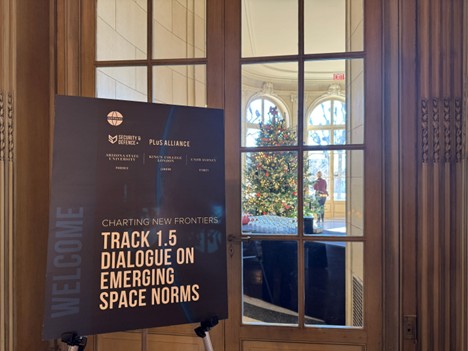
Charting New Frontiers: Track 1.5 Dialogue on Emerging Space Norms
The pace and scale of space activity are rapidly reshaping the space governance landscape, heightening the importance of shared norms to support safety, predictability, and coordination among actors.
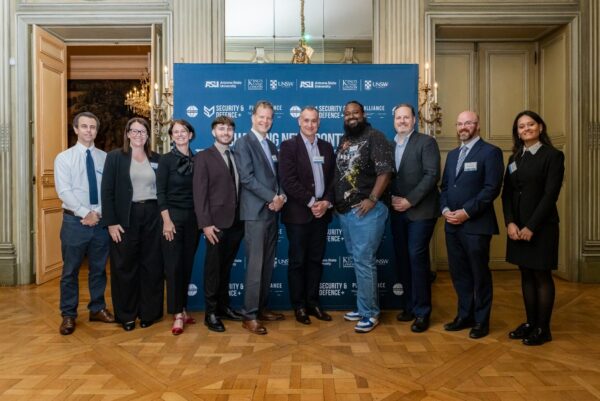
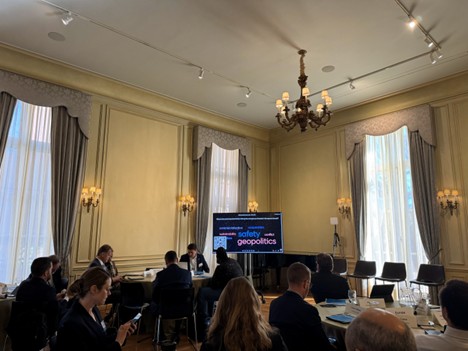
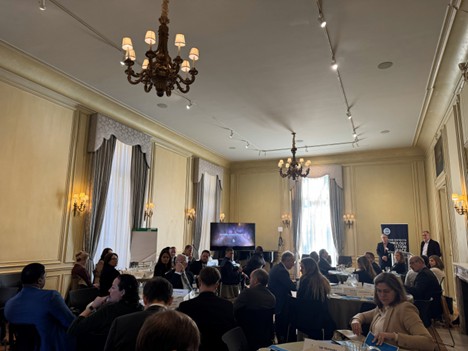
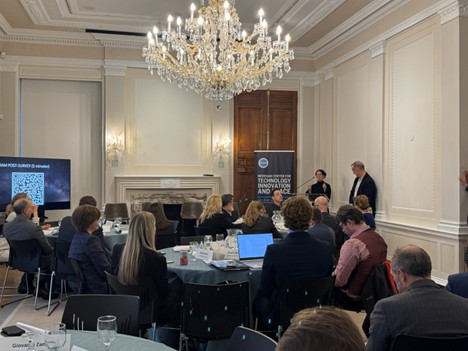
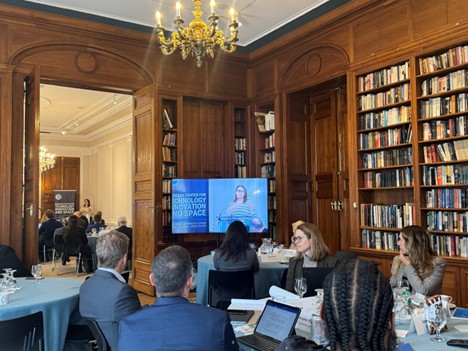
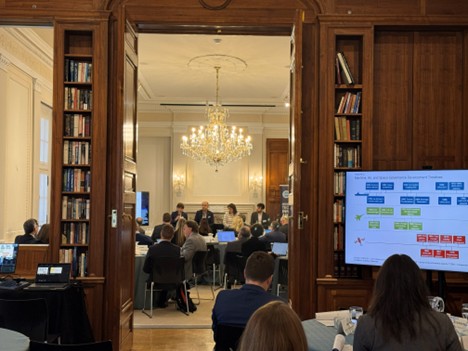
Organized by Arizona State University, King’s College London, and UNSW Canberra under the Security & Defence PLuS Alliance, in partnership with Meridian International Center, the Track 1.5 Dialogue on Emerging Space Norms convened more than 60 leaders from government, industry, academia, civil society, and the security community on December 1–2, 2025, in Washington, DC.
Designed as Workshop “Zero” in a broader, anticipated global series, the Dialogue served as a foundational convening to inform future engagements across regions and sectors. Participants examined what it means to “normalize” space activities amid rapid technological change, expanding commercial activity, and heightened geopolitical competition, including the drivers shaping this process, the risks of fragmented oversight, and the role of public-private coordination in advancing responsible behavior in orbit. The convening underscored the value of sustained, multisector engagement in shaping shared expectations, improving transparency, and advancing practical pathways toward more predictable, interoperable, and responsible space operations.
The program also included an evening program and reception focused on Imagining Space Governance Through Storytelling. Watch here.
While a report identifying insights and best practices from the Dialogue is forthcoming, here is a summary of key takeaways from the gathering. This work may ultimately inform the development of a PLuS Alliance–led database of space norms.
Here Were the Top Takeaways from the Program:
1. Fragmented Oversight
Participants emphasized that oversight of space activities remains fragmented across public and private actors, as well as across jurisdictions with varying levels of expertise and capacity. Gaps persist not only in formal regulatory frameworks but also in shared behavioral expectations. Safety, security, and economic predictability were consistently identified as foundational factors shaping the normalization of space activities and enabling long-term investment and planning.
2. Geopolitical and Commercial Dynamics
Discussions highlighted how geopolitical competition, militarization, and the growing challenge of space debris continue to influence the space governance environment. Participants noted that commercial actors are increasingly positioned to fill capability gaps where governments lack the resources, expertise, or technological capacity to intervene. At the same time, concerns were raised regarding coordination challenges, economic dependence, and the evolving relationship between established spacefaring nations and new entrants.
3. Industry-Driven Norms
The dialogue explored how norms are often shaped by technological development and industry practice, particularly as innovation frequently outpaces regulatory clarity. Participants observed that engineers and technology developers can, in effect, establish de facto norms through design choices and operational practices. This dynamic underscored the importance of proactive, cross-sector coordination to reduce fragmentation and promote consistent, practicable approaches.
4. Implementation and Enforcement
Participants discussed the challenges associated with translating norms into effective practice, noting that norms emerge through both formal regulatory processes and bottom-up industry-led approaches. Effective implementation was seen as dependent on credible enforcement mechanisms, as well as clearer definitions and greater transparency. Interoperable frameworks and improved data sharing were also identified as important enablers of shared understanding and compliance.
5. Lessons from Other Domains
Drawing on examples from aviation, maritime governance, cybersecurity, electromagnetic spectrum management, and the Antarctic Treaty System, participants examined how existing normative frameworks might inform space governance discussions. These analogies provided useful reference points for understanding how norms evolve and are sustained over time. At the same time, participants emphasized that the unique characteristics of space, including rapid technological change, commercial dominance, and geopolitical complexity, require careful adaptation of these lessons.
Looking Ahead
The Track 1.5 Dialogue highlighted the value of sustained, multisector engagement in navigating the evolving space governance landscape. Participants identified opportunities for continued collaboration, including efforts to clarify shared terminology, improve transparency around emerging practices, and strengthen information exchange across sectors. As space activities continue to expand, dialogues of this kind can support greater alignment among stakeholders and contribute to more predictable and responsible approaches to space operations.
With special thanks to Arizona State University, King’s College London, and UNSW Canberra, under the Security & Defence PLuS Alliance, for convening the Dialogue, and to Lead Rapporteur Clara Myle for compiling top takeaways.
Project summary
| Charting New Frontiers: Track 1.5 Dialogue on Emerging Space Norms | January 2026 | |
|---|---|
| Impact Areas: | Science and Technology |
| Program Areas: | Technology, Innovation, & Space |
