

Anchoring the Transatlantic Economy: Global Business Briefing on EU-U.S. Trade with Her Excellency Jovita Neliupšienė, Ambassador of the European Union to the United States

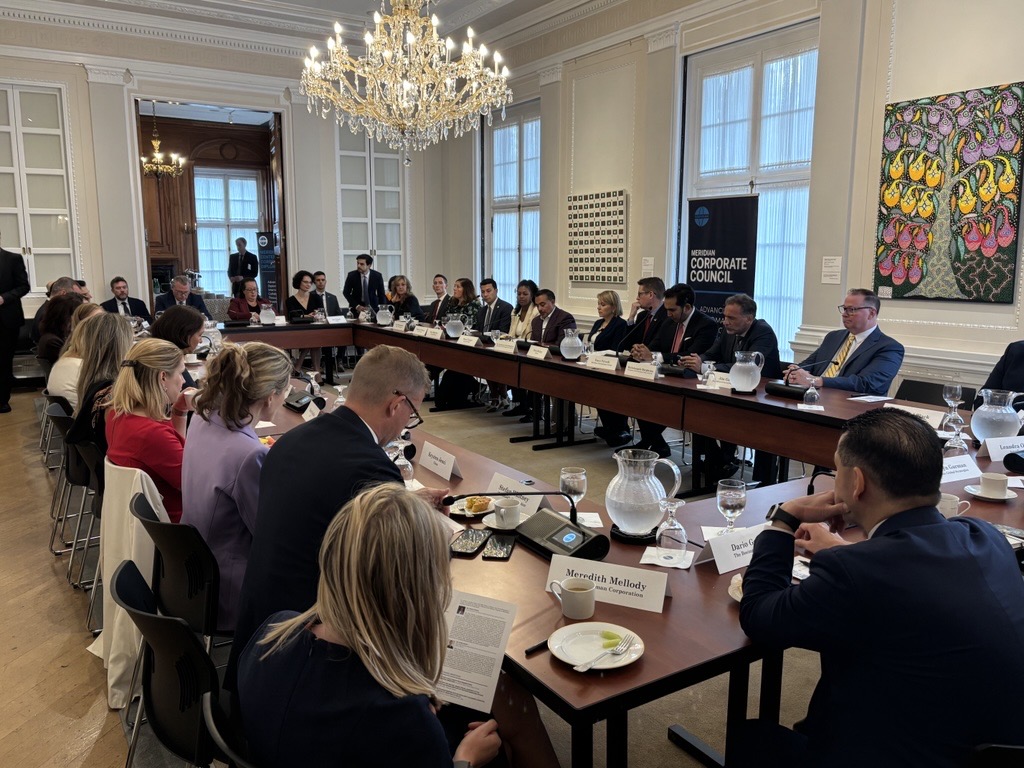
The transatlantic marketplace remains the most integrated in the world, with the European Union and the United States serving as each other’s largest trading partners and investors. Against a backdrop of shifting supply chains, industrial policy debates, and ongoing energy realignments, Meridian’s Corporate Council hosted a Global Business Briefing on September 25, 2025, with Her Excellency Jovita Neliupšienė, Ambassador of the European Union to the United States. The discussion explored the strategic dimensions of the EU-U.S. economic partnership and examined how both sides are working to sustain stability, competitiveness, and cooperation in global commerce.
These were the Top Takeaways from the Program
1. The Transatlantic Economy Is Built on Unmatched Investment
The EU is the largest foreign direct investor in the United States, with cumulative investments exceeding $2.8 trillion as of 2024. American investment in Europe mirrors that scale, creating a nearly balanced flow that underpins millions of jobs on both continents. Together, this integration has generated an estimated $1.5 trillion in annual trade in goods and services, making transatlantic commerce the backbone of the global economy.
2. Momentum Toward Lower Industrial Tariffs
A recently implemented bilateral agreement has lowered tariffs on industrial goods, with the long-term goal of achieving zero tariffs in this sector. Industrial products—from machinery and vehicles to aerospace and construction equipment—form a cornerstone of U.S.-EU trade. Reducing tariffs provides businesses with the predictability needed for long-term planning and investment, while ensuring consumers benefit from lower costs and expanded access to advanced technologies.
3. Energy Security Is Reshaping Europe’s Trade Landscape
The EU has reduced Russian gas imports by 75%, part of a larger pivot toward diversified energy sources. The shift has included an increase in liquefied natural gas imports, the acceleration of renewable projects, and efforts to phase out Russian nuclear technologies. These adjustments strengthen European resilience, stabilize global markets, and create opportunities for deeper U.S.-EU cooperation on energy infrastructure and clean technology.
4. Industrial Policy and “Buy America” Remain Key Points of Tension
Companies have voiced concern about the reach of U.S. industrial policy, particularly Buy America provisions that can complicate exports into the U.S. market. While such policies are designed to strengthen domestic supply chains, they raise questions about exemptions for allied economies and the broader implications for fair competition. How Washington and Brussels navigate this balance will help determine whether transatlantic supply chains remain seamless or fragment under competing industrial strategies.
5. Regulation and Digital Standards Will Shape Competitiveness
From pharmaceuticals and medical devices to AI and cybersecurity, regulatory frameworks are becoming a decisive factor in determining Europe's competitiveness as a market. Simplifying complex rules and ensuring predictability are central to attracting investment and supporting innovation. At the same time, greater alignment between the U.S. and EU on digital regulation and emerging technology standards will be critical to avoiding costly fragmentation. Coordinated approaches can provide businesses with clarity, reinforce trust in cross-border commerce, and ensure transatlantic supply chains remain resilient in a rapidly changing global economy.


Project summary
| Anchoring the Transatlantic Economy: Global Business Briefing on EU-U.S. Trade with Her Excellency Jovita Neliupšienė, Ambassador of the European Union to the United States | September 2025 | |
|---|---|
| Impact Areas: | Business and Trade |
| Program Areas: | Corporate Diplomacy |
