

Five Trends Shaping U.S.-UK Trade, Investment, and Innovation
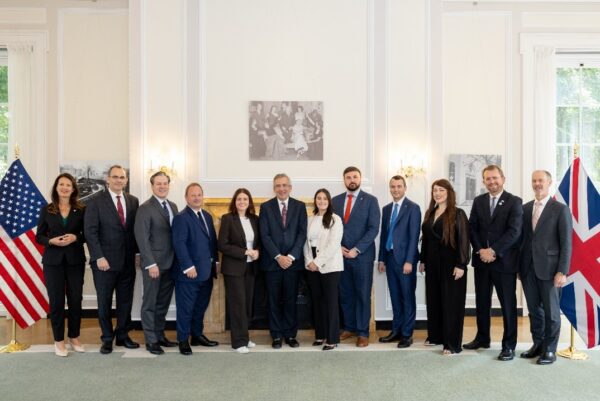
On July 22, 2026, Meridian International Center was proud to welcome Members of the British Parliament, senior corporate executives and U.S. government officials for a roundtable discussion on the future of the U.S.-UK economic relationship. Held in partnership with the U.S. Department of State through the International Visitor Leadership Program (IVLP), the program built on Meridian’s more than 30 years administering the British American Parliamentary Group, a legacy that includes five Members of Parliament and two current cabinet ministers who are IVLP alumni. The conversation examined how both countries can strengthen trade, investment, innovation, and economic security amid a rapidly changing geopolitical environment.
The program featured introductory remarks from Shannon Sprenger, Deputy Assistant Secretary for Professional and Cultural Exchanges, U.S. Department of State, and Robert Post, Director of the Office of International Visitors and U.S. Speaker Program, U.S. Department of State. The discussion also included Mike Schnabel, Vice President of International Operations & Policy at Boeing, and Michael Kennedy, Senior Vice President and Chief Corporate Affairs Officer at Intuit, and was presided over by T.H. David Bohigian, CEO of Meridian International Center, alongside seven Members of the British Parliament representing constituencies across the United Kingdom.
Here are the top takeaways:
1. The U.S.-UK partnership is shifting from free trade to strategic cooperation
The United States and United Kingdom continue to share one of the world's largest investment relationships, but the partnership is increasingly defined by shared efforts to address supply chain resilience, national security challenges, trade policy, innovation, and strategic competition with adverse actors. Because many companies operate across both the UK and European Union, maintaining alignment where possible on regulations, standards, and economic security will make it easier for businesses to invest and compete across the broader transatlantic market.
2. Emerging sectors are anchoring the next chapter of U.S.-UK economic co-development
Life sciences, artificial intelligence, advanced manufacturing, and financial technology are becoming central to the next phase of U.S.-UK economic cooperation. Advancing regulatory coordination across medical devices, pharmaceuticals, biotechnology, and AI-enabled innovation can unlock faster discovery, support market competitiveness, and expand access to transformative solutions for patients and consumers. The UK’s research base and talent pool remain major strategic advantages, while the United States brings scale, capital, and global market reach. Together, both countries are well positioned to co-develop solutions to shared challenges if they can manage AI risks, reduce unnecessary regulatory barriers, and support innovation across sectors.
3. Mid-sized companies need stronger support to scale across the Atlantic
Many promising companies have the ideas, talent, and technical capabilities to succeed but face significant challenges as they grow from startups into larger, more established businesses. Access to capital, workforce needs, regulatory complexity, and market fragmentation can make it difficult for firms to move from early success to long-term scale. A more coordinated regulatory approach across medical devices, pharmaceuticals, biotechnology, and AI-enabled innovation offers a pathway to accelerate scientific advancement, enhance competitiveness, and improve health outcomes worldwide.
4. Sustained engagement and working-level cooperation are essential for long-term success
Strong economic relationships are built not only through high-level meetings, but through consistent follow-up and working-level dialogue between government, industry, and other stakeholders. Regular engagement helps create predictability, trust, and continuity that businesses need to make long-term investment decisions and navigate periods of political or economic change. Participants noted that maintaining open channels across the public and private sectors, and across both sides of the Atlantic, can strengthen regulatory cooperation, support coordinated responses to emerging challenges, and ensure that strategic ambitions translate into durable partnerships and practical outcomes.
5. The value of the U.S.-UK relationship is reinforced through exchange and local impact
The U.S.-UK relationship delivers the greatest impact when trusted relationships are matched with practical action to advance shared goals. Exchange programs such as the International Visitor Leadership Program create space for leaders to learn from one another, build trust, and sustain cooperation during periods of political division. Meridian’s legacy in this work is reflected in its more than 30 years administering the British American Parliamentary Group, as well as the fact that five former British Prime Ministers and two current cabinet ministers are IVLP alumni. At the same time, local communities need to see the tangible value of the relationship through jobs, innovation, investment, and security, including concrete and high-impact examples like American companies contributing to British defense and advanced manufacturing. Reinforcing the partnership requires connecting people-to-people diplomacy with measurable benefits for constituencies on both sides of the Atlantic, a principle that has long informed Meridian's exchange and convening work.






Project summary
| Five Trends Shaping U.S.-UK Trade, Investment, and Innovation | July 2026 |
|---|
