Quick Reference Guide Fact Sheet
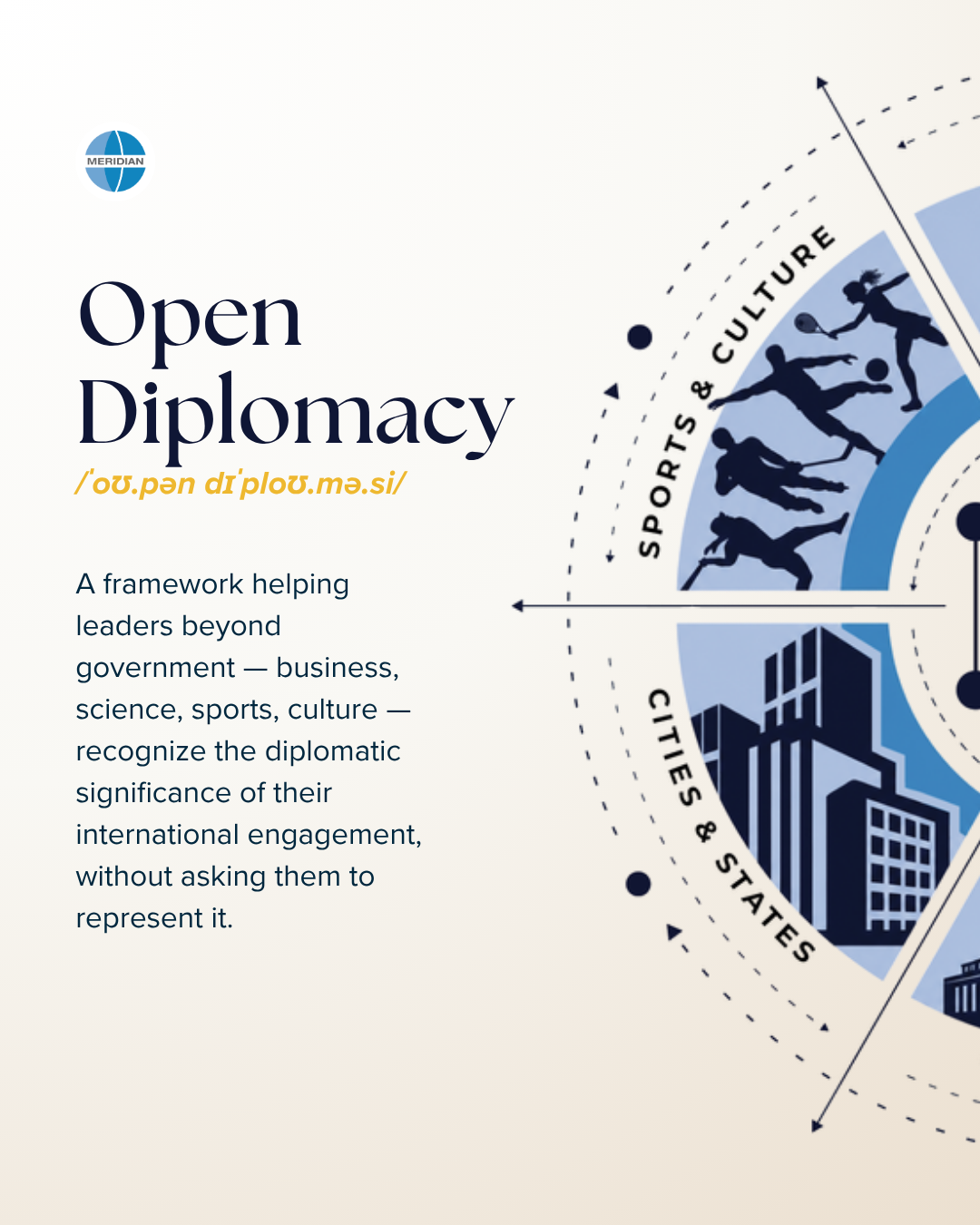
Open Diplomacy is a framework for helping leaders beyond government—across business, science, technology, sports, culture, and civic life—understand the diplomatic significance of their international engagement and connecting them to the networks through which partnerships and influence are built.
This Playbook is designed to move Open Diplomacy from concept to action. It focuses on four areas where non-government actors are already shaping international outcomes at scale—business, science and technology, cities and states, and sports and culture.
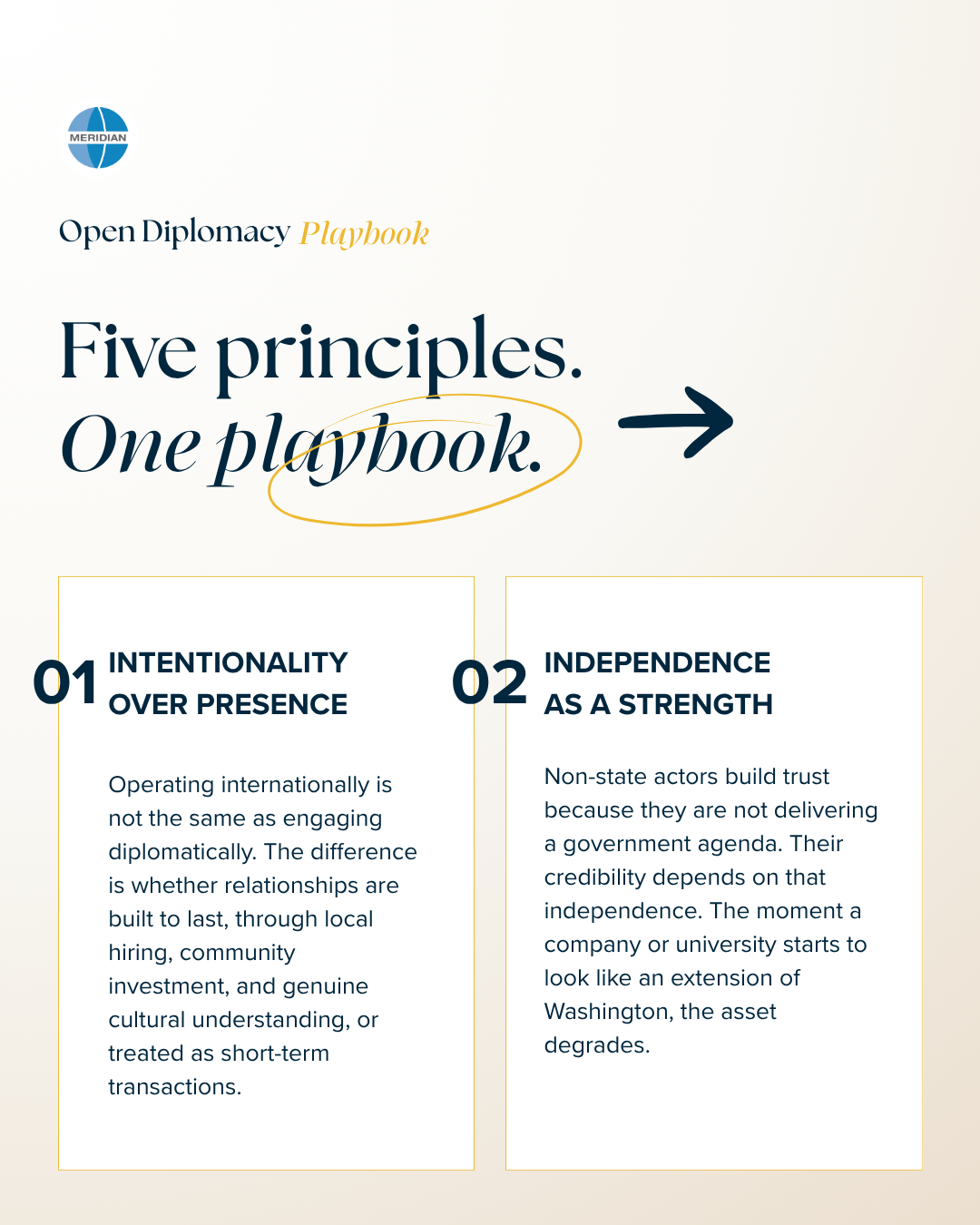
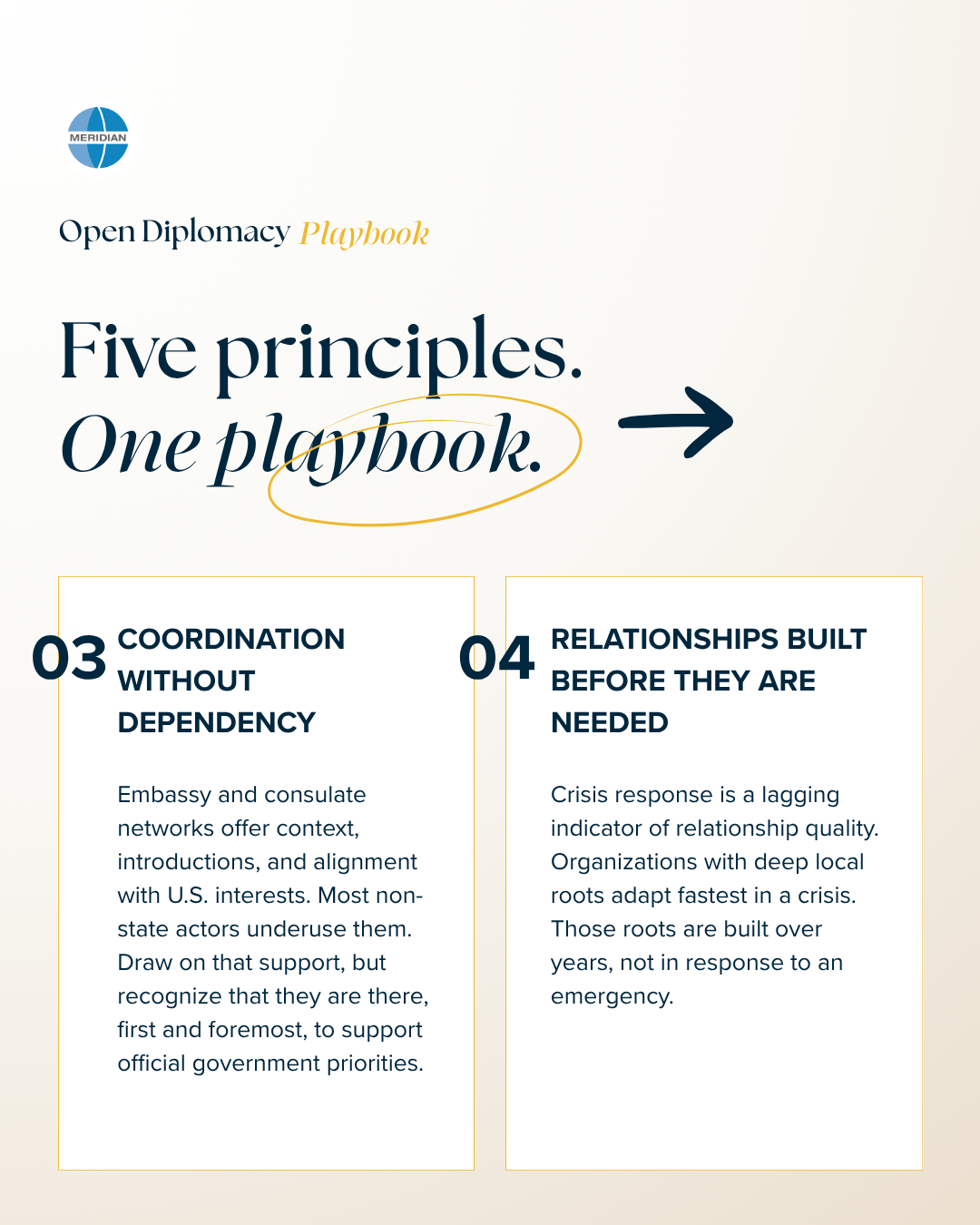
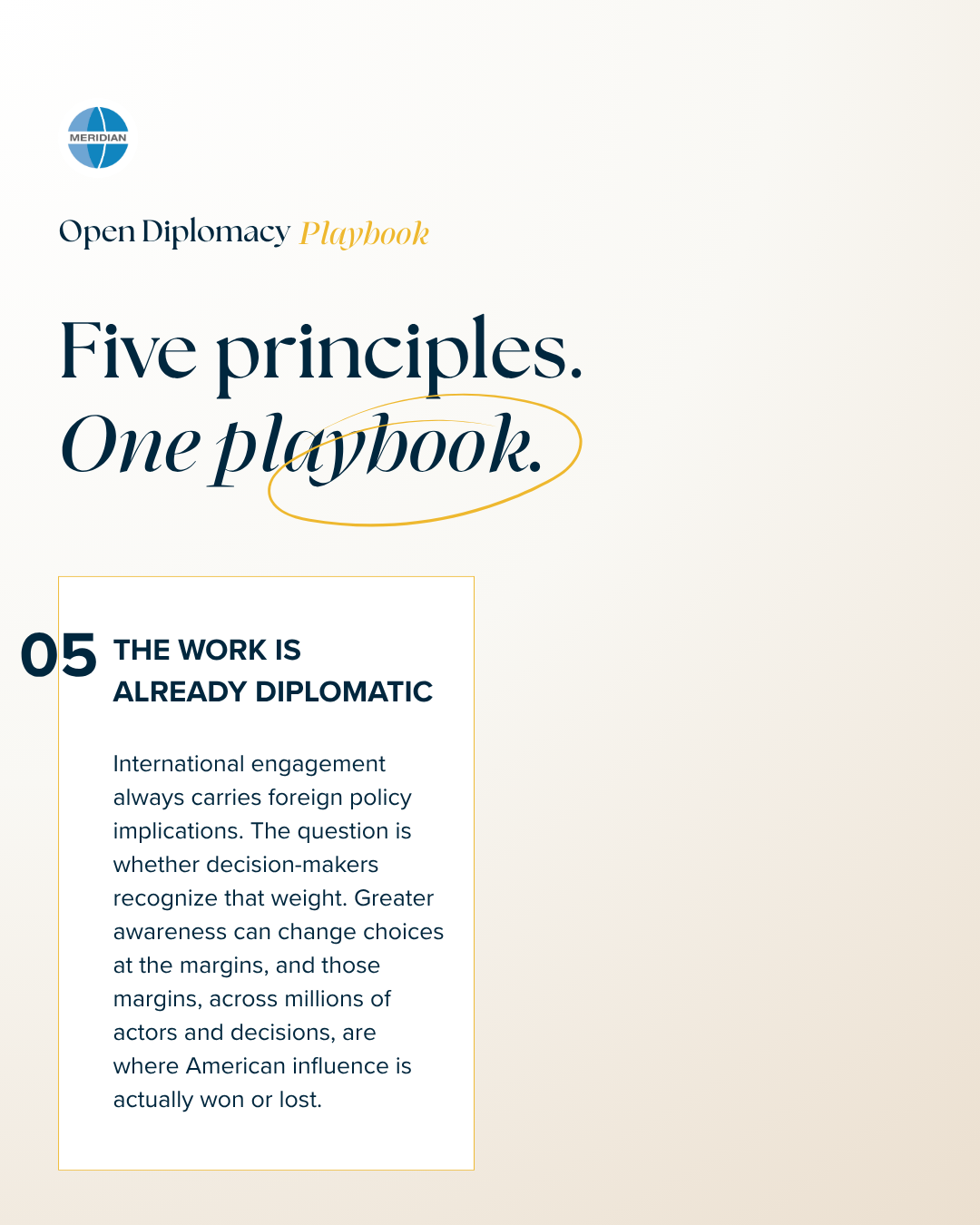
Each section helps leaders identify where they have influence, how their choices are perceived abroad, and how to leverage existing relationships, platforms, and partnerships to build more durable international engagement. Across every sector, the same principles apply: act with intention, preserve credibility, coordinate where useful, and build relationships before they are needed:
The United States has never had more sources of diplomatic power operating in the world today. Much of that power, however, remains underrecognized, uncoordinated, and not used to its full potential.
The institutions built to project American influence abroad—the State Department, the Foreign Service, and the U.S. embassy network—were designed for a world where governments primarily spoke to governments. Outcomes were shaped through treaties, aid packages, and formal negotiations. That architecture remains essential. But on its own, it is no longer enough.
Meridian International Center is grateful to the following individuals who shared their perspectives through interviews, written responses, or prior contributions to Meridian products:
We also extend our sincere thanks to the internal reviewers at Meridian International Center—Lindsay Amini, Max Bouchet, Wyatt Frank, Jim Golsen, TK Harvey, and Kellee Wicker—whose subject matter expertise and editorial guidance strengthened every section of this Playbook.
Additionally, we are grateful to the external reviewers who provided invaluable feedback: Steve Morrissey (United Airlines), Leila Afas (Toyota), Jade Shields and Emily Martin (Ferring Pharmaceuticals), Robert Kapla (Squire Patton Boggs), Benjamin Moore (City of San Diego), Christina Gungoll Lepore (Constitution Partners LLC), Aviva Rosenthal (Smithsonian Institution), David Francis and Travis Murphy (Jetr Global Sports + Entertainment), Laurie E. Locascio, Ph.D. (ANSI), Scott Sellars, Ph.D. (U.S. Department of State), Lauren Wagner, Ph.D. (UCLA), and Dr. Ben Schmitt (Harvard-Smithsonian Center for Astrophysics).
Meridian is especially grateful to T.H. Stuart Holliday for his founding vision of Open Diplomacy; Natalie Jones for her commitment and willingness to seeing this vision through; Liz Allen for her advisory role throughout this project; and T.H. David Bohigian for carrying the Open Diplomacy torch forward.
This Playbook was authored by Riley Nelson, Associate Director of Communications and Marketing at Meridian International Center, and edited by Frank Justice, Vice President of Open Diplomacy Programs. Their dedication to capturing practitioners' voices and translating them into actionable guidance made this project possible.