

The War of Dance: Ballet as a Form of Cultural Diplomacy During the Cold War
By Libby Martin, Meridian Global Leadership Institute participant
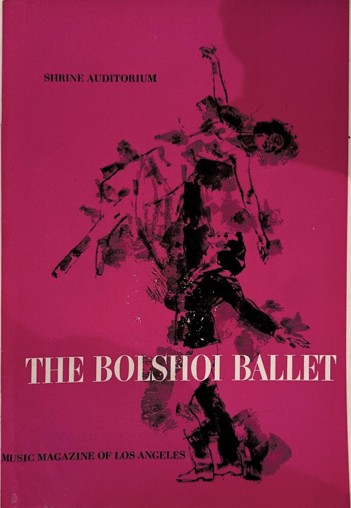
“The last few years have given rise to a new, and strange, kind of terpsichorean diplomacy. Soviet Russia is putting its best foot forward in a satin ballet slipper.”
Humans have been influencing and expanding upon each other's culture since the beginning of human civilization. These cross culture interactions have always had strong influential effects on society, catalyzing the spread of religion, tradition, and language. Ancient empires practiced this cultural exchange through artistic exchange, tributary systems, and royal gifts. Cultural exchange did not transform into a strategic policy exercise until the 19th century as a nation-state system developed initially in Europe, interlinking political boundaries with shared culture. While culture began to intersect with policy in the 19th century, the term cultural diplomacy was not coined until the mid-20th century amidst the Cold War. The term embodies the idea that international cultural programs and activities facilitated by the state became recognized as a strategic tool to conduct or influence foreign affairs.
During the late 1940’s to early 1990’s, the political state of the world was determined by the Cold War, a geopolitical conflict between the USSR and the US, rooted in their conflicting ideas of communism versus capitalism. The US sought to contain the spread of communism, as it viewed the ideology as a threat to democratic freedom, free trade and capitalism. The Soviet Union, on the other hand, aimed to spread communism throughout the world and initially sought to create a “buffer zone” of communist states in Eastern Europe, an idea the US directly opposed. The Cold War arose post World War II; with Germany’s defeat, the USSR and the US emerged as competing world superpowers with these clashing political ideologies.
This period was a time of intense ideological and political tension, and in an effort to ease these tensions, the two countries agreed to an exchange of culture. In 1958, the US and the Soviet Union agreed to the Lacey-Zarubin Agreement on Cultural Exchange, which encouraged cultural and educational exchanges between the two superpowers. The hope was that greater exchange would become “a cultural avenue for fostering detente.” There arose the beginnings of official cultural diplomacy, with both countries using music, art, and education not only as a means of easing tensions, but also as propaganda to demonstrate superiority through their culture rather than weaponry.
“[T]he tours were not organized merely to be pleasant . . . They were set up to end the Cold War, either by encouraging detente through artistic collaboration or by persuading the audience to adopt a new ideology."
One of the most prominent examples of the cultural exchange at this time was the ballet exchange, with corresponding tours of the Bolshoi Ballet in the US and the American Ballet Theatre and the New York City Ballet in the Soviet Union. Ballet as an art form originated in the Italian renaissance courts and then in France. It was brought to Russia in the late 17th century during the reign of Peter the Great as a symbol of Imperial Russia. Since then, ballet has been a crucial part of Russian culture, and Russia has reformed their style of ballet to embody nationalistic pride and discipline. In the United States, ballet began to spread through the country as European tours arrived in the 18th century. It wasn’t until 1935, however, that the first US ballet company was established when George Balenchine, a former Soviet dancer, and Lincon Kirstein founded the American Ballet Company. At the beginning of the Cold War, ballet was fairly new in the US and thus, was not nearly as embedded in American society and identity as it was in Russia. But, as ballet rose as a new art form in the US, it quickly became a form of cultural expression and even cultural competition between the two countries.
During the Cold War the US and USSR utilized the exchange of ballet and its cultural diplomacy to uplift themselves on the cultural stage. The spread of ballet and programs around it became a form of political propaganda to influence global public opinion. The political cachet of ballet became so strong that dancers in the Soviet Union were able to use the power of ballet to gain agency for themselves, by using the travel opportunities granted to them through ballet to defect to the US.
Section 1: The USSR and US both used the exchange of ballet troupes as propaganda, in an effort to alter the public’s view of their country by demonstrating the superiority of their distinct art forms as a representation of the superiority of their political system
As part of the Lacey-Zarubin Agreement on Cultural Exchange, the USSR launched a campaign to infiltrate the US to demonstrate their cultural sophistication through ballet exchanges. The USSR had already sent several ballet troupes to other nations since the start of the Cold War. The Russians “discovered that art can be a valuable weapon in the propaganda war with the West, and for this reason Kruschchev . . . sent the Bolshoi on several sorties into the capitalist camp.” The Russians believed that they “could use culture as a weapon,” and that by demonstrating their “value and support for their artistic heritage” they could attract other European and Middle East nations to form alliances with them over the capitalist US with its more “vulgar, commercial society, denuded of culture.” Notably, they believed that the Bolshoi Ballet was a particularly effective tool for propaganda; “in the Bolshoi with its nearly 200-year old tradition, the Soviet leaders have discovered to their delight a sure-fire cultural export likely to win admiration for the hammer and sickle.” This intention to use the ballet as a tool for propaganda was even included in newspaper stories in Russia.
“The Russians are perfectly candid about it. Prima Ballerina Ulanova expressed it this way in an article in a Moscow newspaper when the troupe returned from a successful tour of Western Europe: ‘In meeting the people of various social strata and walks of life, we were glad to witness how gross misconceptions of the soviet people dissolved one after another in the minds of many West Germans under the influence of the art of the Bolshio Ballet.’ ”
Many of the dancers had never traveled outside Russia. As reported in a New York Times article at the time, “It [was] only the fourth time in almost two centuries that the world-famous ballet [had] been outside Russia.” Because the Russian ballet tours had rarely performed internationally, their performance in the US gained significant attention.
The Soviets campaign to capture American attention with their art was successful as American media reflected America's infatuation with the Soviet ballet. Reports in The New York Times demonstrated America’s appreciation for the Russian style of dance. One article exclaimed, “The Soviet Union’s Bolshoi ballet opened its first American tour last night to the thunderous applause and excited bravos of a glittering audience at the Metropolitan Opera House,” depicting the enamored American reaction to the Bolshoi Ballet’s first performance in the US. The report revealed the awe Americans felt watching the Russian ballet and the initial success of the Bolshoi Ballet’s tour. The article went on to describe the ballet: “Seldom has such an international atmosphere of glamour and excitement been stirred in New York in many years,” showing the immense social impact the ballet performances had in the US. Finally, describing the atmosphere of the ballet as “glamour[ous]” reinforced the sophistication of the Russian ballet and raised them up on a cultural level. This article fully reflected America’s perception of Russian ballet in a manner that the USSR hoped to achieve by sending their ballet troupes to America.
With their ballet tours, Russia aimed to infiltrate not only America, but specifically the elite of American society, the "intelligentsia," to illustrate their cultural superiority and associate the Russian ballet with higher class values. The tours only visited major cities in the US like New York, as the target audience for these ballet performances along with many politically powerful figures resided there. By targeting America’s upper class in major US cities, the Soviet Union associated the ballet with elite American society and further uplifted the ballet. For seats to the shows, the “Ticket Prices may range from $7.50 to $25, probably the highest ever charged for a continuing attraction in New York.” The high price of the tickets reflected the high demand to see the Bolshoi Ballet perform in the United States. Not only were the tickets priced high, but they were “the highest ever charged,” illustrating that the ballet was even more expensive than America’s own elite attractions in their major cities. Finally, the “Bolshoi Ballet . . . gave the last performance seen in the Old Metropolitan Opera House.” The famous Metropolitan Opera House was a premiere cultural landmark on Broadway and the heart of American opera for over 80 years. Just by performing there, the USSR ballet gained the sophistication associated with the historic opera house. Giving the Russian ballet the honorary last performance, however, showed their prestige through an American lens.
The US began to send troupes to Russia, demonstrating their more modern take on the traditionally structured Soviet ballet with America’s more flexible and free approach.
The American Ballet Theatre will appear in the Soviet Union early next summer under the sponsorship of the President's Special International Program for Cultural Presentations, . . . This will be the first Russian visit by any American ballet company.
In particular, the American ballet troupe was introducing “a completely new style of ballet.” The emphasis on stylistic differences between the two ballets was intended to reflect the broader differences between their cultures. At the same time, “[t]he American group presented variations on Glazunov’s ‘Raimonda,’ Britten’s ‘Fanfares’ and Bizet’s C Major Symphony.” By “presenting variations” on traditional Russian ballets, the American ballet companies modernized traditional ballet and highlighted the stylistic differences between the two.
The US intended to use these tours as a means of political propaganda as well. The US hoped that the ballet exchanges would highlight American culture; “[p]erhaps the most popular explanation for the exchange in the United States at the time was the assertion that it enabled free American culture to undermine the Soviet government's credibility with its intelligentsia.”
The ballet tours also became a tool for political leverage, with each country threatening and canceling performances to demonstrate their displeasure with the other’s broader geopolitical positions. In 1970 for example, “The Soviet government . . . canceled a scheduled US tour of the Bolshoi theater and threatened to break off cultural relations with the United States in retaliation for ‘zionist provocations.’” The Soviet government threatened to take away the ballet as leverage over the US, reportedly stating “These Acts, Kuznetsov said, ‘not only create obstacles for the Soviet institution in America in the fulfillment of their functions and threaten the break-up of activities connected with cultural exchanges.’” These strategically timed cancellations were not only used by the USSR, but also became a global strategic tactic. For example, in France, “French authorities ‘postponed indefinitely’ the ballet’s scheduled appearances because of the bitter anti-communist sentiment roused by the Red conquest of Dien Bien.” The pattern of different countries threatening the cancellation of ballet for political gain illustrated that this was an established strategy globally and emphasized the ballet’s importance to global cultural diplomacy as propaganda.
As the USSR continued to implement their ballet performances abroad, it slowly became evident that these performances were becoming permanent attractions rather than temporary tours. One newspaper article detailed, “The largest contingent of soviet performers, 535 in all, ever to visit the United States will arrive in April 1968,” demonstrating the increasing presence of the Soviet ballet in the US. The increasing number reinforced the success of the Russian ballet within the US, as their tours not only continued to grow in size but in popularity. The Bolshoi Ballet even began to prepare for a continued presence in the US, as one Russian director said that they would “build new sets and make new costumes for use here.” The permanence of imobile pieces of sets being produced in the US, rather than in Russia, showed the extent to which Russia was establishing themselves within American society through these ballets. And its plan for an ongoing presence demonstrated the continued popularity of the Bolshoi Ballet to American audiences. The continued popularity of the Russian ballet also meant it was making money. By contrast, American tours in Russia were subsidized by the US government; “American tours in the Soviet Union lost money while the Soviet tours in the United States made money.” With the continued popularity and lucrative tours of the Russian ballet in the US, the Soviets achieved their goal of demonstrating the cultural superiority of the Russian ballet. In effect, the Soviets “won” the cultural diplomacy or propaganda battle with respect to the ballet. It did not translate, however, into the broader victory of demonstrating the superiority of the Soviet communist state as the Russians had hoped.
Section 2: Russian ballet dancers began to capitalize on the travel opportunities granted to them through ballet, to defect to the US for political and societal reasons, while Russia tried to force them back to defend their global image.
Russian Dancers used travel opportunities for performances to defect to the US for the broader freedom the US offered them. American journalists capitalized on these defections in their biased reports to praise American society and diminish the USSR. American journalists reported that “Bolshoi Ballet star Alexander Godunov, the fourth major soviet dancer to defect to the West in recent years, was granted political asylum in the United States.” These defections cast a negative light on the USSR, as multiple of their top dancers desired to leave. The same article reported that “[i]n asking for asylum, Godunov followed the same route that brought such Soviet greats as Nureyev, Baryshnikov and Natalia Makarova to this country, all of them former dancers for the Kirov Ballet of Leningrad.” By emphasizing the stories of defecting dancers seeking “political asylum," American reporters portrayed America as a safe haven for those who sought freedom, while depicting the Soviet Union as a restrictive society whose dancers desperately wanted to leave. This contrast invited Americans to see Soviet defections as evidence of the superiority of America’s free society.
Many Russian dancers explicitly planned their defection around these ballet tours and used artistic freedom within dance as a viable reason for their defection, showing how ballet catalyzed defections. Reportedly, Soviet dancer, “Godunov, one of the leading male dancers of the 125-member troupe that [was] touring the United States, defected during the company's fourth and final week at the State Theater in Lincoln Center.” In this case, the lead dancer defected to the US as the company was preparing to return to the USSR. Specifically, “Godunov told immigration officials he left the company because he felt ‘restrained in his artistic life.’” While the opportunity and freedom in the US was rooted in dance style, the US depiction of America in these reports reflected the message they wanted to spread, that the US was a freer country in all aspects. In another article about a defecting dancer, “THE KYODO news service said, Mrs. Messerer apparently had planned her defection because she had been depositing her savings in a foreign bank in Tokyo. The Asahi Shimbun newspaper quoted police sources as saying the two ‘despaired life in Russian society.’” The premeditation of these defections and the police quote from them revealed a disdain towards Russian society and reflected poorly upon the Russian image.
The freedom America offered was a common motivation for Russian dancers’ defections, extending beyond just artistic freedom to broader political and societal freedoms. In American news during Leonid and Valentina Kozlov defections, the New York Times revealed that “Mrs. Kozlov also sought religious freedom in this country.” During the Cold War, Russia had an unofficial policy of state atheism. While Russia never made religion illegal, they used extreme measures to severely limit their citizens from practicing any religion. This specific defection demonstrated how dancers were not only defecting from Russia for artistic freedom, but also for the societal freedom that the US offered, like religious freedoms. During the Cold War these Soviet defections inspired by the individual liberties offered in the US, further strengthened the US’s global image as a free country. The media’s repeated focus on the Soviet dancers’ desire to live free in the US drew attention and even support from individuals in other countries who envied the freer lifestyle in the US.
Russia's reaction to the defected dancers, and their persistent attempts to force them to re-join the Soviet Union, highlighted the important role the dancers played in promoting Russia’s global image. American journalists believed: “left to themselves, [the Soviets] would not make a fuss at all, and that they enter the fray only when an artist's defection is made much of in the Western press. Nevertheless, it remains true that each defection is seen not only as a sin against the Motherland but also as a political threat.” Depicting the defections as a “sin” against the country emphasized how poorly these defections reflected on Russia. American commentary helped to cement the perception that the USSR’s main concern was the stain the defections imposed on their public image and, thus, diminished their global image. In a later article, the report revealed the USSR lying about defectors experience in US:
“The 33-year-old dancer, Yuri Stepanov, denied as "inventions" statements attributed to him in an April 1980 article in the government newspaper Izvestia. The statements said the church group that helped him in the United States was a front for the CIA; that the American "special services" tried to recruit him as a spy; that other Soviet defectors in America lived lives of alcoholism, degradation and despair; that his stay in the United States was a "nightmare," and that he was "boundlessly happy" to be back in his homeland. "That's all nonsense," Stepanov said. "They simply used me. They decided to make my case an object lesson to other Soviet ballet dancers so as to discourage any more of them from defecting when their companies went on tour abroad’”
By portraying the US in a negative light through a false quote in a Soviet government newspaper, the USSR attempted to taint the reputation of the US. But, Stepanov’s repudiation of the Soviet Union’s false narratives not only restored the US reputation, but further diminished the Soviets’ public image.
Russia’s aggressive attempts to forcefully reinstate their dancers reflects their desire to maintain a positive global reputation rather than to protect the individual dancers. For example, “A Soviet ballet dancer who defected to the United States returned to Moscow last year ‘because [he] was afraid of reprisals against [his] family,’ and not, as the Soviet press asserted, because he was disillusioned with the American way of life.” Here, American journalists demonstrated how the Soviets insisted on bringing the dancers back to the USSR by threatening them and their families. Additionally, upon their return to the USSR, the Soviets attempted to diminish America’s public image while reinforcing their own by saying the defectors were “disillusioned with the American way of life.” In some cases, the Soviets were successful in their attempts to reverse these defections. Soviet reports began warning against defections, claiming that: "He who abandons the hands where he was born comes, as a rule, to a sorry end. Trying to get more somewhere else, he finishes up with nothing.” This section depicted Russia’s critical attitude towards defectors, and attempted to dissuade others from defecting by stating that they will get nowhere else by going to a different country. While Russia tried to mitigate its image, the defections of high profile dancers gave the US additional tools for their propaganda efforts to depict the US and democracy as a superior political system.
During the Cold War, both the US and the Soviet Union used ballet not merely as a gracious cultural exchange program but also as propaganda to exemplify cultural and political superiority. The more the public loved their ballet, the more superior their country would be on the global stage. The Soviets believed that when people saw their disciplined, sophisticated dancers, they would conclude that their rigid state controlled system must be superior as well. In contrast, the US hoped the freer and more expressive dance of their ballet troupes would inspire Russians to demand more freedom.
Ironically, both countries were winners and losers. Russia proved its ballet’s superiority by enthralling American society with the precision and grace of its dancers, but America’s admiration for their art of dance did not endear them to the broader Russian culture and rigid communist state. Instead, the Russian ballet’s successful tours in America exposed Russian dancers to the individual and political freedoms offered in America and inspired the Russian dancers to defect and embrace America. The US used the defections to try to expose the harsh realities of communism and glorify the individual freedoms of a capitalist society. In the end, the high profile defections of the Russian dancers in search of more artistic freedom became a more powerful political propaganda tool for the US than the superiority of the Russian ballet troupe.